BBC
News
September 1, 2007
Original
Article
Most
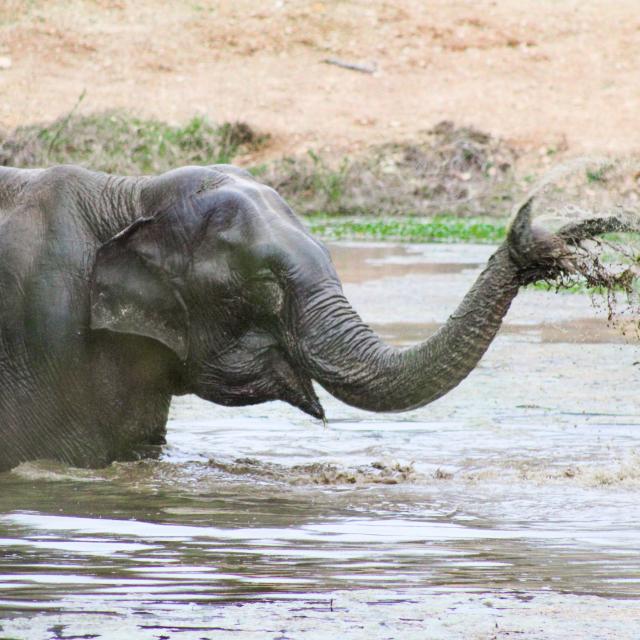
Bornean elephants
are no taller than people
Scientists
helping protect the smallest and rarest elephants
in the world are hoping to set up a fieldwork
centre on the island of Borneo.
The Bornean elephant is only found
in the northern part of the island and was recognised
as a new subspecies in 2003.
Cardiff University has also studied
orang-utans in the Malaysian state of Sabah,
Borneo, for several years.
The rainforest where both species live has been
damaged by logging and the growth of oil palm
plantations.
The elephants live in the Kinabatangan
flood plain in Sabah and there are thought to
be around 1,500 - 2,000 in the wild.
The team from Cardiff University's school of
biosciences has been working with the authorities
in Sabah on conservation projects for many years.
Mike Bruford, professor of biodiversity, has
just returned from Borneo where he was discussing
opening the field centre along with the Sabah
wildlife department.
An orang-utan swings above the toilet
of a village
in the reserve
He said: "The elephants are all around,
huge numbers of elephants that get very close.
At the end of the day they come down to the river.
"They are the smallest elephants in world
and very interesting. We've been trying to work
out how habitat changes have affected them."
He said that while the larger males are above
6ft 6in (2m) tall, the majority of Bornean elephants
are less tall than he is.
Prof Bruford added: "Where they used to
roam freely, there are plantations all around.
"Although they are doing reasonably well,
they are increasingly coming into contact with
people."
Conservation charity WWF has also been tracking
the elephants' movements using radio collars.
Although elephants are in trouble everywhere,
said Prof Bruford, the Bornean species was "by
far" the smallest population.
A management plan is currently
being developed to find ways to protect them.
A
man said 'would you like to see an orang-utan?'
...What
he meant was, I've got one in my back garden
above the dunny
Professor Mike Bruford
While in Borneo, the Cardiff University team
were also finalising plans to conserve the orang-utans
on the reserve and protect their habitats.
The Kinabatangan is one of the major reserves
in Sabah and has large areas of oil palm plantation
where the rainforest was chopped down for timber
in the 1960s and '70s.
Only small patches of rainforest on either side
of the river remain, explained Prof Bruford,
surrounded by massive oil palm plantations that
are of no use to the animals.
In Borneo, the Cardiff University team had a
stark illustration of how species such as orang-utan
are getting closer to people.
"We got to a village and a man said 'would
you like to see an orang-utan?'. We thought he
might have captured them.
"What he meant was, I've got
one in my back garden above the dunny."
Ropes across rivers or roads
can
help the orang-utans move around
They saw a male orang-utan just 15 metres away,
swinging in the trees with the discarded husks
of his fruit lunch dropping on to the toilet
below.
Prof Bruford said: "There is no conflict
at the moment but there could easily be.
"This type of problem in the rainforest
is something we will increasingly face so it
is important to work in such places."
He added: "We are continuing to work there
in collaboration with the Sabah wildlife department
and are setting up a little field centre with
them next year."
Studies of the elephants, orang-utans and other
species would be carried out there.
|