Boston
Globe
June 28, 2007
By Colin Nickerson, Globe Staff
Original
Article
Elephants aren't bashful about
speaking their minds. Anyone who has ever watched
a National Geographic television special knows
all about those long trumpeting blasts.
Big animals, big sounds -- sounds
meant mainly for other elephants' big ears, or
so wildlife specialists long assumed.
But a Stanford University scientist
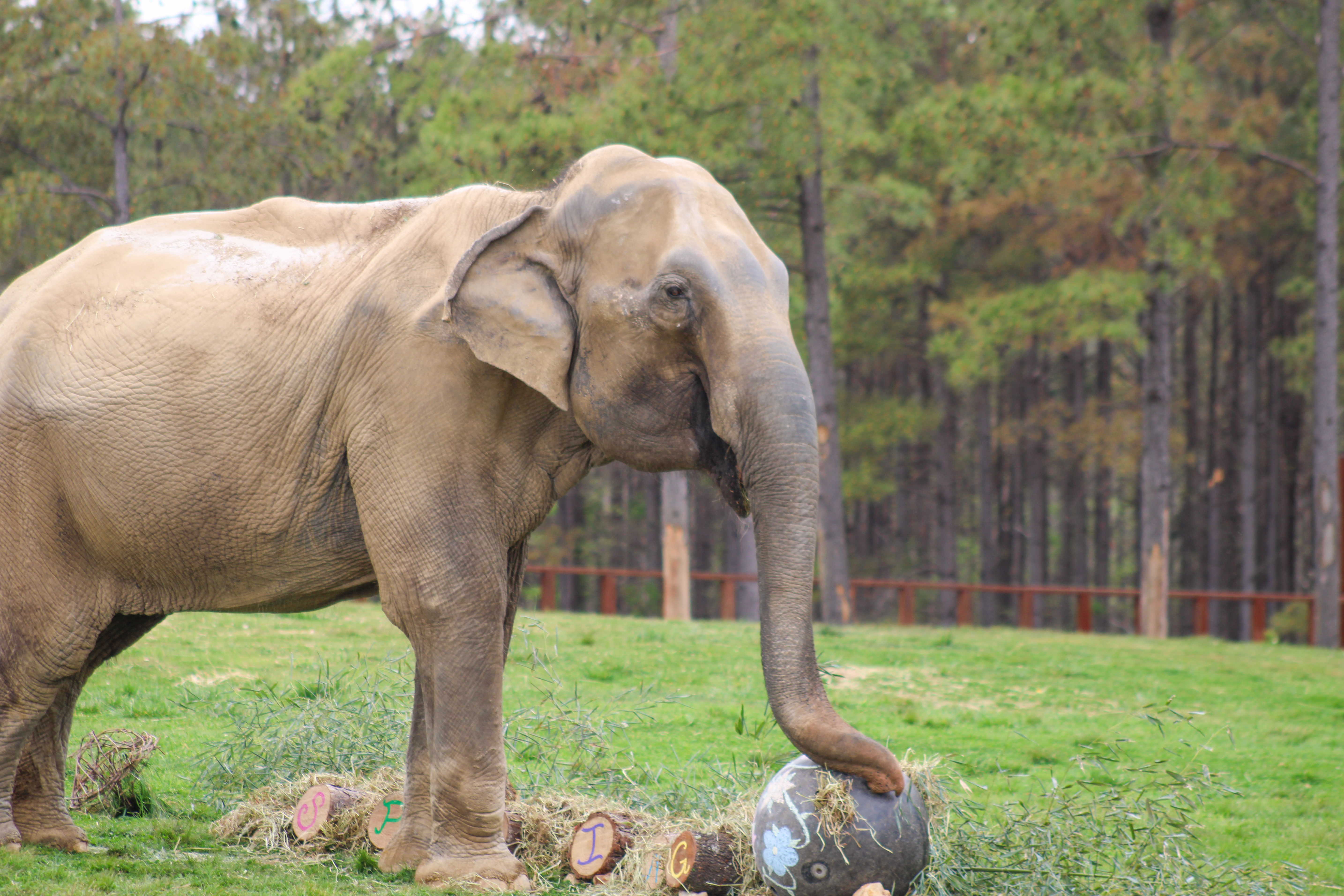
has discovered that elephants actually have two
distinct ways of communicating: by ordinary soundwaves
rippling through the air, and by vibrations transmitted
through the ground to exquisitely sensitive elephant
toes.
The seismic waves are set in motion
by the same "low-frequency vocalizations" that
famously rumble across African savannas, said Caitlin O'Connell-Rodwell.
The ground sounds travel a greater distance than
airborne calls, and may help keep herd members
in touch with one another across a dozen or more
miles.
Through these ground vibrations,
O'Connell-Rodwell suggested, elephants are able
to raise long-distance alarms, offer advice,
advertise love yearnings, or just swap greetings:
Lions aprowl! Succulent forage over here! Mate
wanted!
GLOBE GRAPHIC:
'Caller ID of the wild'
(Globe Staff Graphic / James Abundis)
VIDEO: Studying elephants' long-distance communications
"They are talking through
the ground," O'Connell-Rodwell said. "It's
not just elephant-to-elephant noise. It's a richer system of communication
than we'd thought. They can discriminate very subtle vibrations through
their feet."
In O'Connell-Rodwell's latest
study, scheduled to be published next month,
the elephant specialist reports these seismic
signals are so sophisticated that elephants can
distinguish whether the messaging comes from
trusted fellow herd members or strangers -- a
sort of "caller ID of
the wild," according
to O'Connell-Rodwell. The next step in her research is to figure
out how the elephants make these distinctions.
"With elephants, listening
is not just what is picked up by their ears," she
said by phone from Namibia, the southern African nation where
for 15 summers she has studied migrating elephants
at Etosha National Park. She and her colleagues
are also studying elephant communication at California's
Oakland Zoo.
In close quarters, those floppy
ears work just fine. To reach elephants miles
away, the low-frequency vibrations channel through
soil, and clay represents the more reliable long-distance
service.
The "listening" elephant
catches the vibrations with its toes, behind
which lie pads of acoustically sensitive fat.
Similar tissue is in the heels of the elephant's
feet and in its trunk, which augment the toe
sensors. The vibrations speed along bones to
the elephant's middle ear. They are processed
in the auditory cortex area of the brain, just
like regular sound.
The Stanford work in Namibia
marks the first time scientists have studied
seismic communication in large land animals.
Several small mammals are known to be acutely
sensitive to ground vibrations, including the
kangaroo rat, which recognizes its siblings through
their signature foot drummings, according to O'Connell-Rodwell.
Eventually, according to audiology
researchers, O'Connell-Rodwell's work could yield
a human pay off by contributing to techniques
for helping the deaf "hear" through
vibrations.
"Understanding a communication mode in nonhuman species has implications
for developing rehabilitation strategies in humans with sensory defects," said
Gerald Popelka, chief of audiology at Stanford. A patient who cannot be
helped by conventional means, such as surgery or hearing aids, "may
be directed toward developing communication through the sense of touch," using
vibrations much as elephants do, he said.
Before O'Connell-Rodwell started
her work in Namibia, researchers had already
established that elephants produce powerful,
low-frequency calls that can travel through the
air to herd members up to 6 miles away.
Now O'Connell-Rodwell's research
suggests elephants may be able to at least double
that communication distance with toe talk.
"We haven't been able to measure how far the vibrations can be understood,
but we think the seismic messages are travelling farther than the airborne
waves," O'Connell-Rodwell
said, estimating that 12 or 13 miles might be a realistic range, but that
the seismic waves -- unlike air sound, which quickly dissipates -- theoretically "have
no outer limit." Part of this summer's research will involve trying
to determine how far elephants can actually "hear" through
the ground -- it could be a much larger distance, she said.
Meanwhile, elephants not only
can decipher the meaning of the low-frequency
transmissions, O'Connell-Rodwell said, they can
tell exactly who is sending them.
In experiments, O'Connell-Rodwell
recorded seismic "danger signals"'
-- specifically, warnings about lions -- one trumpeted by elephants
from another herd in Namibia and nearly identical calls from elephants
in Kenya, on the opposite side of the continent.
Using electronic equipment, her team then transmitted the rumblings
into the ground near Etosha's Mushara water hole.
The Etosha elephants reacted instantly to the warning sent by
the fellow Namibian herd, tightening into defensive groups, putting
pressure on their toes to "fine-tune" the
rumbles, and, finally, shuffling nervously from the water hole, according
to O'Connell-Rodwell.
The warning cries from the Kenyan elephants, by contrast, elicited
almost no response -- the elephant equivalent of a shrug of the
shoulders.
Apparently, elephants don't heed
advice from strangers. That may be smart or foolish,
depending on the circumstances. But the experiment
suggests that elephants know exactly who they
are listening to with their tootsies.
"They will react to an individual
they consider worth paying attention to," said
O'Connell-Rodwell. "When the warnings come from elephants
they know, they take the message seriously. But they don't respond
to callers whose identities are a mystery."
Another possibility is that elephants
in Namibia and Kenya "speak" in
mutually unintelligible dialects, like Spanish and Portuguese,
but O'Connell-Rodwell suspects not. The tones of the warning
cries are too similar in duration and frequency modulation.
"It seems more a matter of trust," O'Connell-Rodwell said, offering
her interpretation of the data. "A strange elephant isn't
a reliable source of information, even about lions."
As a control, O'Connell-Rodwell
and her team, using technology devised by Stanford
mechanical engineer Sunil Puria, also sent a
series of meaningless sounds into the ground.
Again, no response from the Etosha elephants.
Sensitivity to vibrations may
also explain the extraordinary ability of elephants
to suddenly start heading toward regions of rain,
hundreds of miles, in search of green fodder.
It may be they are detecting the faint vibration
from distant thunder and understand it signals
a good feed.
O'Connell-Rodwell, a researcher
for the department of otolaryngology at Stanford's
School of Medicine, will provide scientific details
of her most recent experiments in the August issue of the Journal
of the Acoustical Society of America. In March, she published
a well-reviewed book, "The
Elephant's Secret Sense: The Hidden Life of the Wild Herds of Africa," explaining
her ideas of elephant communication to general readers and offering
rousing, often poetic accounts of her adventures in the bush.
O'Connell-Rodwell started out
as a bug expert, trained as an entomologist.
In a tiny, soundproof chamber she spent days
on end recording the love serenades of Hawaiian
planthoppers, an insect that communicates through
vibrations carried through its limbs, not sound.
O'Connell-Rodwell switched to
bigger beasts during a 1992 trip to Africa, where
she snared a job advising Namibian farmers how
to protect their crops against elephants without harming the
creatures. She became intrigued by how they communicate.
"I didn't see it then, but I see now that I was embarking on my life's journey," said
O'Connell-Rodwell, who with her husband, Tim Rodwell, a physician
and epidemiologist, directs a nonprofit organization, Utopia Scientific (www.utopiascientific.org),
which raises funding for elephant conservation and science.
"We think what we're learning
could be used to help babies born with hearing
impairments, but very sensitive to vibrations for the first 11
months," she
said. "For now, though, we've got so very much more to learn
about how elephants communicate. They are smart, subtle creatures,
and not always easy to understand."
© Copyright 2007 Globe Newspaper Company. |