Reuters
UK
August 24, 2007
By Christian Tsoumou
Original
Article
BRAZZAVILLE (Reuters) - Herds of
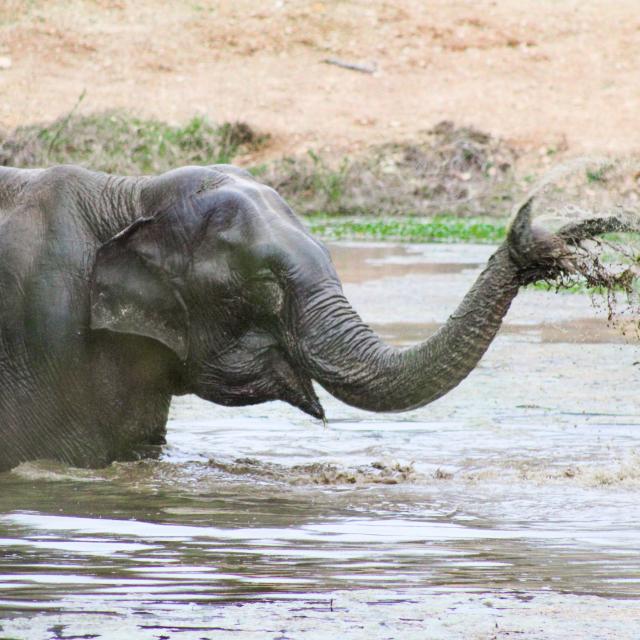
elephants are trampling crops and polluting water
sources in eastern Republic of Congo, threatening
to force thousands of villagers out of their
homes, the forestry minister said on Friday.
Around 10,000 people in Ingouni-Moke and Olounou
I, 250 km (155 miles) north of the capital Brazzaville,
have been in a stand-off for more than a week
with the elephants which have laid waste their
manioc fields.
"There is a proliferation of pachyderms.
Today we have nearly 30,000 whereas in the 1980s
we had only around 10,000," Forestry Minister
Henri Djombo said.
"In most of the country's forested areas,
the population is complaining about the destruction
of their fields by elephants who come and eat
their bananas and manioc."
Elephants are protected by law in Congo and
there is little under-resourced villagers can
do to keep them at bay. In the past some have
burned bricks of dung mixed with chillis to produce
a pungent smoke which drives off the animals.
Forest elephants are smaller than their savannah
cousins and tend to be more reclusive, moving
around in small groups rather than large herds
and generally avoiding contact with humans.
But a lack of food has driven them out of the
rain forest and towards tempting fields of bananas
or rice. They can consume about 500 kg (1,100
lb) per day.
Rampant poaching in the 1980s threatened
to wipe out elephant populations until an international
treaty virtually halted the worldwide ivory trade.
Despite the destruction they cause, Djombo said
the Congolese were proud of their pachyderms.
"The law allows us to carry out authorised
culls to dissuade the animals but we use it very
little," he said.
"Partly so as not to encourage poachers
but also because we consider the situation to
be a positive result of our conservation policy
-- the proliferation of species said to be threatened
globally is a source of pride for our country."
During a 1997-1999 civil war, the population
of Mbomo in the north protected the Odzala national
park from the bloodletting, a marked contrast
to neighbouring Democratic Republic of Congo,
where nine rare mountain gorillas have been shot
dead in a park where armed militias roam.
A senior forestry ministry official has been
dispatched to Ingouni-Moke and Olounou I to lend "moral
support" to the villagers and assess the
damage. Last year, the state paid 10 million
CFA (10,295 pounds) in compensation to one locality
alone.
"We envisage finding technical solutions,
like barriers sufficiently solid to stop the
elephants getting to villages and fields. But
for the time being we are limiting ourselves
to compensation," Djombo said.
"Today, the population is a partner in
conservation ... The slaughter of protected animals
is reported whenever it happens. That is a sign
of a real public awareness."
|