June 14, 2006
SeedMagazine.Com
By
G. A Bradshaw
Original Article
New research is blurring the species boundary, forcing us to rethink
what it is to be human
Picture
a psychiatrist at her desk reviewing a case file. The report describes
a young, teenaged male who, with several others his age, killed
nearly a hundred victims. The case is astounding—not only
because of the intensity and magnitude of the violence, but because
nothing remotely like it has ever happened in the community before.
Not even a single murder. As the psychiatrist turns the pages and
reads on, the pieces of the puzzle start to come together. A few
years before, the young killers had witnessed the massacre of their
families and been orphaned. Afterwards, although still very young,
they were relocated to another community with few adults to raise
them; importantly, it was absent of older, mentoring males.
Resignedly, the psychiatrist writes her opinion: post-traumatic
stress disorder (PTSD). She recommends intensive counselling and
psychotherapy. Trauma and social breakdown—in this case, loss
of a mother and community—compromise normal brain and behavior
development, often resulting in hyper-aggression, violence and other
asocial behaviors. Although treatment is called for, such developmental
trauma, in the absence of family and friends who can psychologically,
emotionally and physically support recovery, often leads to a pattern
of psychobiological disorders. Trauma becomes neurobiologically
etched and may be transmitted across generations. Unfortunately,
the teenagers' story echoes those of many others, each unpleasantly
familiar in their association with a string of wars and genocide
in Uganda, Rwanda, Iraq and Sudan. However, there is something different
and perhaps more disturbing about this account.
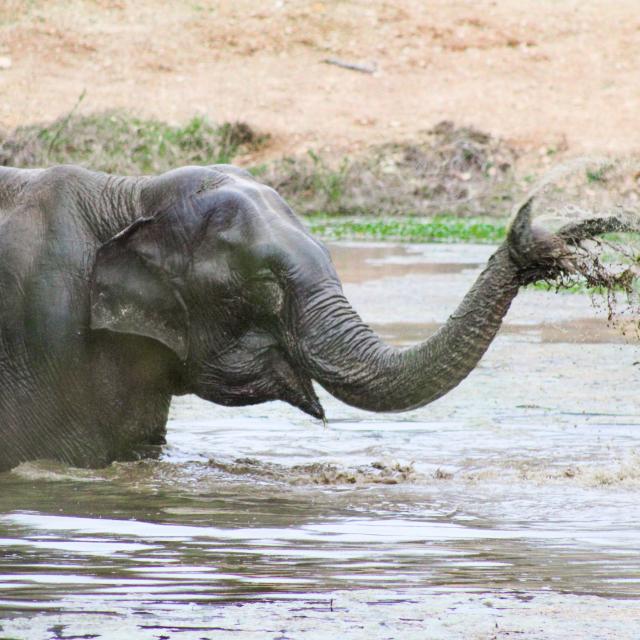
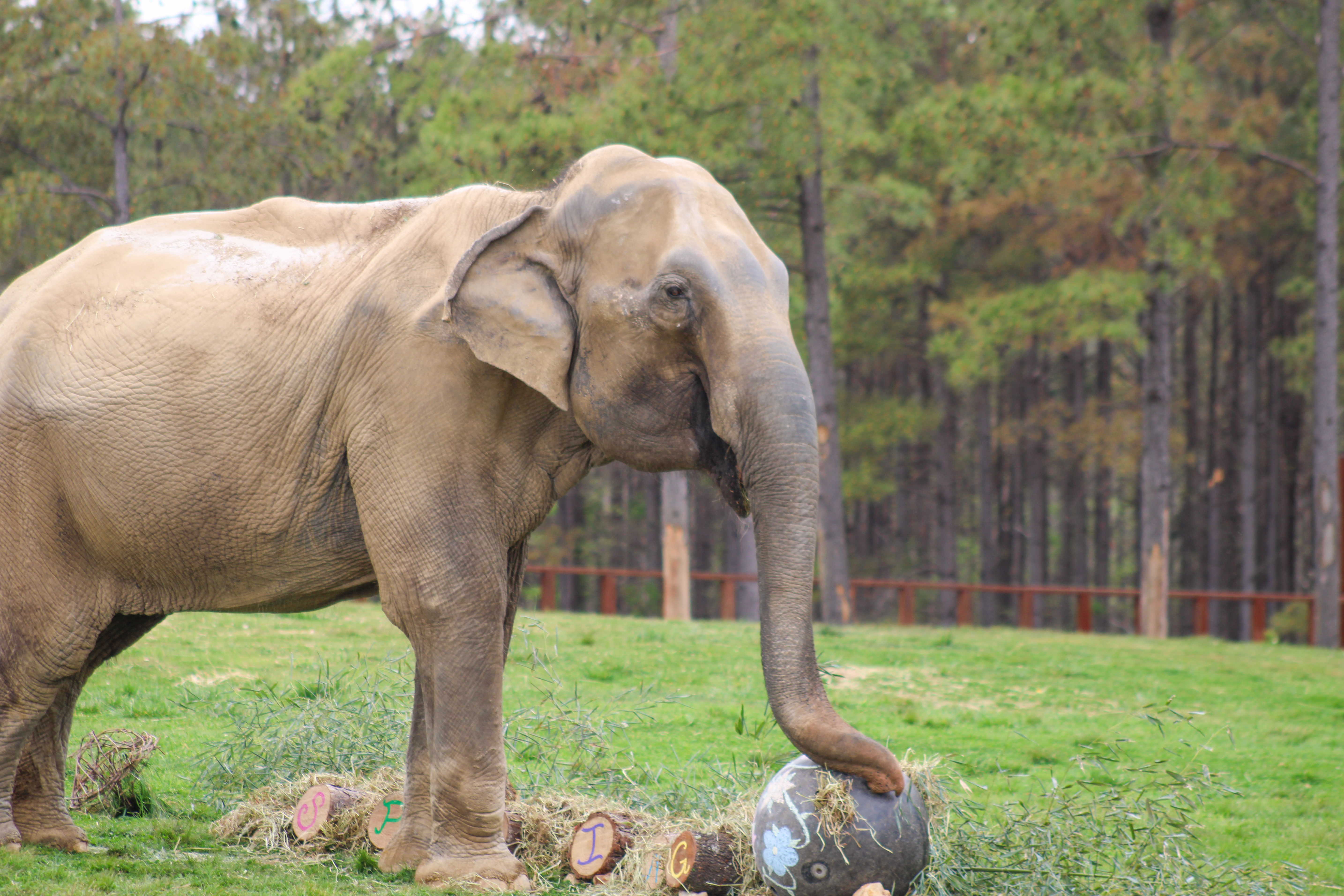
These teenagers are young male African elephants. At a South African
park, in the 1990's, three young males attacked and killed 58 white
and five black rhinoceroses; at a second park, young male elephants
killed 40 white rhinoceroses. While these events have by far been
the most dramatic, elsewhere in Africa and Asia, reports of elephant
aggression are appearing more frequently. Moreover, violence is
not just directed at other species. In yet another African park,
male-on-male intraspecific mortality is responsible for 70% to 90%
of adult male elephant deaths.
Until recently, these types of behavior have been almost unheard
of, leaving conservation biologists searching for an explanation.
Habitat destruction, starvation, social breakdown from poaching
and culls, and the loss of herd coherence are factors known to severely
threaten elephant survival. But the levels and types of atypical
behavior being observed suggest an added dimension to the problem.
Some biologists think that increased elephant aggression might comprise,
in part, revenge against humans for accidental or deliberate elephant
deaths. Could it be that elephants, like humans, also suffer psychological
trauma as a result of violence?
Until a few years ago, making such inference and diagnosing elephants
with PTSD would have been dismissed as anthropomorphism. But no
longer. Elephant psychopathology, chimpanzee infanticide and other
un-animal-like behaviors are part of a growing body of research
that suggests science is building toward a radical paradigm shift.
Streams of new data and theories, critically from neuroscience,
are converging into a new, trans-species model of the psyche. Humans
are being reinstated back into the species continuum that Darwin
articulated, a continuum that includes laughing rats, octopuses
with personalities, sheep who read emotions from the faces of their
family members and tool-wielding crows.
We now understand that all vertebrates, and it is argued even some
invertebrates, share many biological structures and processes that
underlie attributes once considered uniquely human: empathy, personality,
culture, emotion, language, intention, tool-use and violence. Furthermore,
we are able to see beyond species differences in ways we have never
been able to before. Neuroimaging advances such as PET and fMRI
can help map more elusive subjective qualities—such as emotion,
states of consciousness and sense of self—to specific regions
of the brain. In conjunction with a rich legacy of observational
data and theories on animal behavior and human psychology, neuroscience
is bridging long-standing conceptual and perceptual gaps.
Whether or not this paradigm shift conforms precisely to science
philosopher Thomas Kuhn's definition, its potential effects on science
and society are revolutionary. The idea that humans share a psyche
with other animals is enormously challenging. First, it alters the
basic model around which biomedical and other disciplines have organized
theory and terminology. Concepts like sense of self, empathy and
intention have largely been considered exclusive to humans, and
have therefore defined what animals are not. Such perceived dissimilarities
have shaped theory, practice, law and custom for centuries. The
human-animal gap influences how we live, how we formulate scientific
questions, how we practice science and even what we eat. Today,
in contrast, models of species' similarity are replacing models
of difference, and the lines between species have become increasingly
blurred—blurred to the extent that many insist on limits to
stem cell-chimera research to avoid mixing the neuronal and psychological
capacities of humans and other species.
In itself, similarity among species is not new. Animal models that
employ diverse species as surrogate humans have long been a staple
of scientific research. Together, rats, mice, cats, dogs, apes and
even invertebrates form the backbone of the biomedical and anthropological
research that shapes the theories, practices and policies of human
health and well-being. It is this understanding of relatedness that
grounds scientific inference and makes studies on animals translatable
to humans. Consequently, violent elephants and rats with a sense
of humor are not remarkable because of the similarities they expose,
per se, but because of the specific nature of the similarities.
For instance, the notion of "at-risk elephants" conflicts
with our sense of what defines an elephant as well as what defines
a human being. Because so much of human identity—who, how
and what we are—has been based on what other species appear
to lack, the possibility of a shared, trans-species model of brain
and psyche simultaneously prompts us to reflect on what it means
to be human.
Nonetheless, similarity does not confer identity—and species'
differences do exist. The task before us is to understand the significance
and meaning of these differences, under a paradigm of similarity.
An apple and an orange are both fruits and therefore the same if
we are comparing fruits with doughnuts. But their differences become
important when we are trying to decide which one to eat. The same
holds true for the species we study. Since so much of science has
been built on, and references, the assumption of human-animal difference,
shifting to a model of human-animal similarity recalibrates the
scale by which differences are measured. Accordingly then, today's
theory, practice, law and customs in science and society, which
have been shaped by human-animal dissimilarities, must be revised.
Clearly, ethical considerations may be compelled to change, but
science itself is also affected. For example, consider how intraspecific
violence and infanticide in multiple species might now be assessed.
Diverse explanations have been put forward, largely depending on
the species. From the perspective of evolutionary psychology, primate
infanticide can be seen as an adaptive reproductive strategy. On
the other hand, in our society, these behaviors are regarded as
abnormal and dealt with by the law and psychiatry. A trans-species
model of vertebrate brain and behavior requires resolving whether
this atypical behavior observed in chimpanzees and elephants is
a disorder caused by trauma or an adaptive strategy. How might one
or the other conclusion affect science's current theories and practice,
conservation and even law?
Neuroscience has made it possible to make inferences about animals
from humans, in much the same way as animal models have been long
used to infer human behavior from animals. Inference, then, is no
longer unidirectional—and, it seems, models of the psyche
are no longer limited to humans. Future historians of science may
very well look back and consider the violent young elephants as
symbols of a dramatic epistemic turning point in science and culture.
For now, they have helped us realize that neuroscience has brought
us much more understanding about what it means to be—no matter
the species.
—Gay Bradshaw is on the faculty of Oregon State University's
Environmental Sciences Graduate Program. She is currently completing
her second book, Elephant Breakdown: The Psychological Study of
Animal Cultures in Crisis.