March 13, 2006
Toronto Star
By
Janie Robinson and Brian Quinn
Original Article
When most logging work dried up, the
elephants of this Southeast Asian country
were cast aside, until `Lek' stepped
in to help
BRIAN
QUINN PHOTO
It's all fun, but also deeply rewarding
`work' for volunteers - many of them
Canadians - who are helping concerned
locals give a humane new life to Thailand's
threatened population of domestic Asian
elephants at the Chiang Mail Elephant
Nature Park.
Chiang
Mai, Thailand —Canadian
Jeff Smith doesn't seem to notice the
massive Asian elephants ambling past
the construction site as he continues
what looks like a game of charades with
his Thai work crew.
"I'm learning more and more Thai every day," says the
26-year-old engineer/project manager of Elephant Nature Park north
of Chiang Mai, Thailand. "But I'm never sure if their nodding
heads and smiles mean they understand me and my hand gestures until
I see what they've actually built."
The former Junior Canadian ice dance champion has traded in his
skates for a degree in environmental engineering and the challenges
of working in the wilds of northern Thailand. "If you think
me talking about building plans with these guys looks funny, you
should see their faces when I try to explain figure skating to them," Smith
says with a laugh. The Orillia, Ont., native spent many years training
at Barrie's Mariposa School of Skating.
"I wanted to do some environmental volunteering while my friend
and I were backpacking through Southeast Asia," explains the
University of Waterloo grad. "I came to Elephant Nature Park
to volunteer for a couple of weeks and loved it so much I ended
up staying for three months."
A 386-hectare reserve located 56 kilometres north of Chiang Mai,
Elephant Nature Park is dedicated to the conservation and care of
Thailand's threatened population of domestic Asian elephants. Even
though these majestic animals are revered in Thailand, their future
here could be grim. There were 100,000 elephants a century ago,
25,000 a decade ago and today, only 5,000 elephants survive in Thailand,
an overall decline of 95 per cent.
Logging was banned in 1989, putting most of Thailand's domestic
elephants out of work. Tourism has now taken over as the main employer;
at tourist trekking camps in northern Thailand, in circus-like shows,
and panhandling in city streets where tourists pay to feed the elephants
bananas.
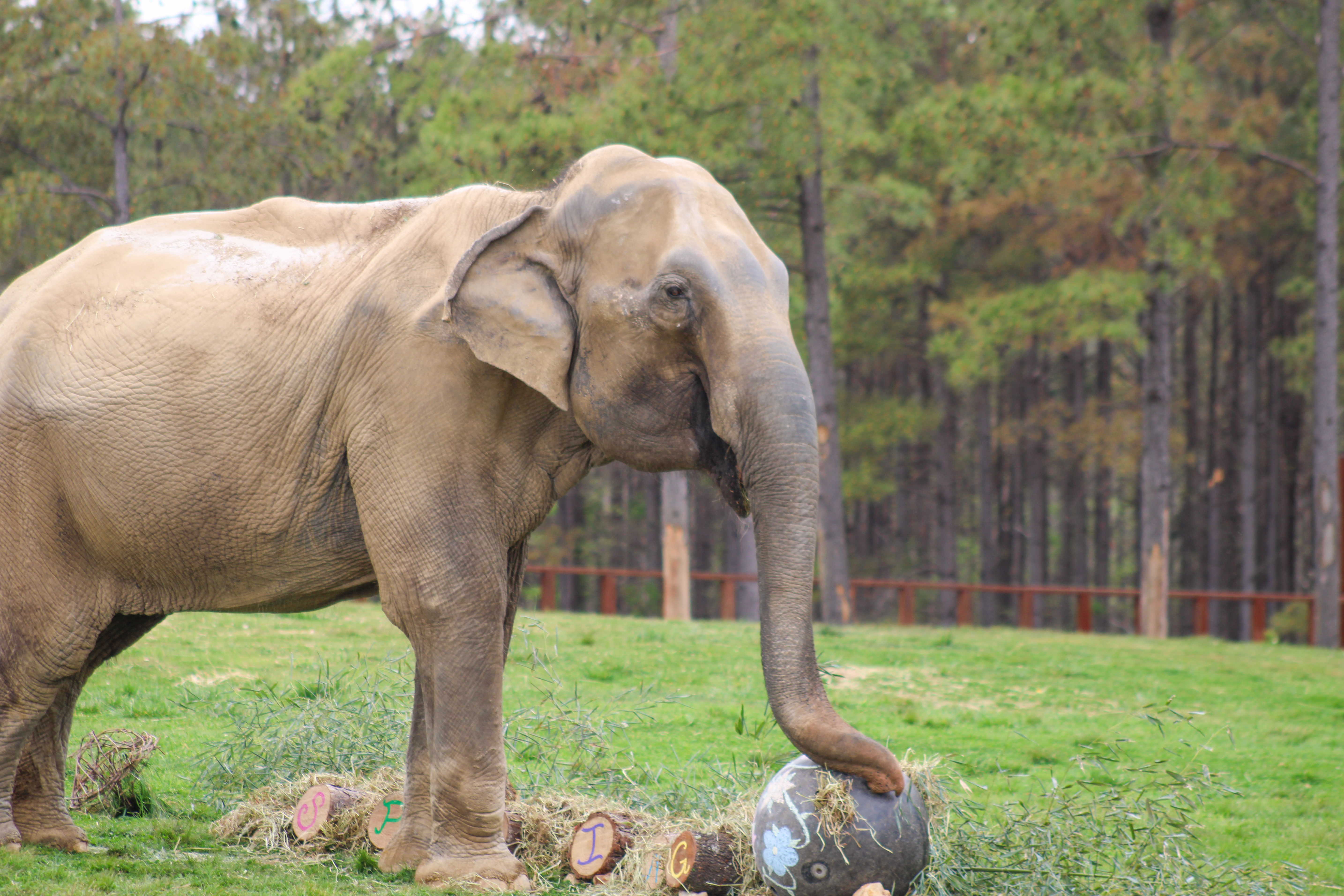
Elephant Nature Park offers a rare alternative to such tourist
fare, giving visitors a more natural, humane experience, including
feeding and bathing this growing family of "saved" domestic
elephants. As well, there is the opportunity to interact with these
amazing animals as they wander freely in open fields, through hilly
jungle-like forests and splash along winding rivers.
Elephant Nature Park's founder and director Sangduen Chailert,
known as "Lek" (which mean "little one" in Thai),
leads the growing movement for more humane treatment of elephants
in Thailand.
"We need very quickly to educate people and do something
to save these beautiful creatures,'' says the country's one-woman
humane society. "Without elephants Thailand is like an empty
country. I will work to help elephants until I die... I will never
stop!"
Recently voted Time magazine's 2005 Asia Hero of the Year in the
activist category, this petite Thai woman continues to fight big
battles for the giant charges she has rescued over the past 10 years,
bringing them to live in the natural sanctuary of Elephant Nature
Park.
Blind elephant Jokia was adopted by Lek in 1999. Jokia had stopped
working, after suffering a miscarriage while dragging heavy timber
loads up steep hills at an illegal lumber camp. Then, in an attempt
to get her working again, she was blinded by slingshots and arrows.
Hope was just six days old when Lek came to his rescue. A farmer
had killed Hope's mother, and the orphaned baby was discovered near
death three days later. Now a big, boisterous 5-year-old, Hope is
another living testament to Lek's loving, training and life-long
commitment to Thailand's elephants.
Lek hopes that giving visitors and volunteers some quality time
with Hope, Jokia and the rest of her rescued herd at Elephant Nature
Park will encourage tourism to evolve toward this kind of more natural
experience.
"I can't keep up," says Canadian Cally Ashby, hand-feeding
a massive white elephant named Mae Boom Ma, who wraps her trunk
around the cucumbers and pops them into her mouth faster than the
Port Hope woman can hand them to her. Bananas, watermelon and squash
are also on the lunch menu (just a fraction of the 225 kg of forage
these elephants will eat on average per day).
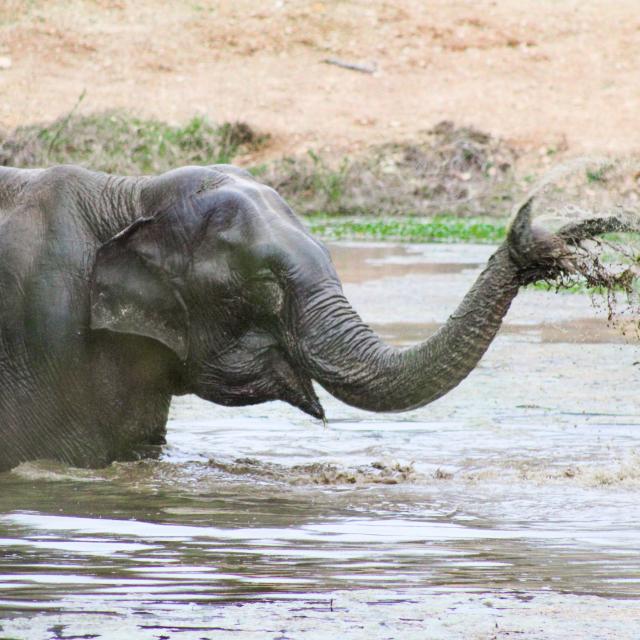
After lunch, it's down to the river for a bath and splash with
these massive creatures, obviously in their element. Cally and her
friends, 23-year-old Port Hope twins Rosie and Evelyn Dell get almost
as wet as the elephants, thanks to the playful splashing of both
the elephants and their mischievous mahouts (elephant trainers).
The two baby elephants Tong Jan and Kanoon make short work of
their bath, spraying sand on themselves (and everyone in the general
vicinity) before heading off with the rest of the herd and park
guests for the daily walk in the park.
While day visitors head back for the hour-long journey to Chiang
Mai, weekly volunteers settle in for a tasty Thai buffet dinner
and surprisingly comfortable sleep on the mosquito-netted mattress
situated on the floor of the rustic sleeping huts.
"Volunteers can be as busy or relaxed as they choose," park
host Michelle Cullen tells us. "Jobs vary from bathing and
feeding elephants to helping with their basic health care. One of
our conservation projects involves tying holy Buddhist cloth on
trees throughout the rain forest, protecting them from cutting (according
to a Thai religious belief). Or you can always help with building
and maintenance around the park."
Ottawa's Megan Ironside has spent much of her volunteer time teaching
English to eager mahouts, while learning about local and tribal
lifestyles and culture. "I've been a volunteer at Elephant
Nature Park for five weeks and I hope to come back here in October
on my honeymoon," the 27-year-old tells us.
One of the highlights of the volunteer program is an overnight
adventure at a sanctuary known as Elephant Haven — hiking
high through the rainforest as the elephants head to their mountain-top
retreat. With our sleeping bags spread over grass mats and wrapped
in mosquito nets in the bamboo hut, we relax around a campfire under
the stars. The elephants' bells chime in the distance as the contented
creatures enjoy their night of freedom in this hilltop haven.
Early the next morning, we help the mahouts round up any errant
elephants for the hike back to the park. Considering their size,
it can be surprisingly tricky to spot these massive creatures in
the dense rain forest. One of them, mischievous Jungle Boy, knows
tricks like how to plug his elephant bell with mud and sticks to
stop it from ringing and giving him away.
After just a few fascinating days as volunteers at Elephant Nature
Park, it's easy to see why Smith has returned to Chiang Mai to continue
the environmental engineering work he started as a volunteer.
"I feel like I can really make a difference here. It's great
to be able to use my university degree and be so involved in all
aspects of a project," Smith explains of his role, overseeing
everything from water resource management to building design and
construction, volunteer recruitment and administrative work alongside
park founder, Lek.
"When things aren't going right on the building site or at
the office, I just take an hour and hang out with one of the elephants, " Smith
says. "It's the best therapy you could ever have."
For more on the visitor and volunteer programs at Elephant Nature
Park visit http://www.elephantnaturepark.org