December 28, 2005
The Washington Post
by Robert Strauss
Original Article
PHILADELPHIA -- A vintage advertising poster from the mid-20th
century hangs in the offices of the Philadelphia Zoo. It has a yellow
background with a semi-Art Deco drawing of an elephant and says "Visit
the zoo. Open every day."
Some things haven't changed at the Philadelphia Zoo, America's
oldest, founded in 1874. It is still open every day and, for the
time being, it still has elephants. But in Philadelphia, as in zoos
around the country, the question of whether elephants should be
kept at all zoos -- or maybe even any zoo -- has almost abruptly
become a sensitive one.
"I can tell you that if the animal rights people had picked
the elephant shrew instead of the elephant, no one would be calling
me," said Mark C. Reed, the executive director of the Sedgwick
County Zoo in Wichita, Kan., and the head of the Elephant Task Force
of the American Zoo and Aquarium Association. "They are a flagship
animal. To some people, elephants mean Africa or Asia. I look at
them as the representatives for species in the wild."
Three zoos have discontinued their elephant exhibits over the past
year, and this fall the Philadelphia Zoo decided to put on hold
plans to build a new and larger elephant habitat. The zoo's board
decided to fund a $20 million big-cat habitat, a new aviary and
an update of the children's zoo instead of a new area for the zoo's
four elephants.
A protest group, Friends of the Philly Zoo Elephants, has claimed
this as a victory. The group maintains that elephants are roaming
and foraging animals and need more space than zoos can give them.
It and other animal rights activists say that penned-in elephants
tend to get diseases and injuries they would not get in the wild.
The Philadelphia group is pressing the zoo to donate its elephants
to a sanctuary in Tennessee.
"I know it's the right thing to do. Whether the zoo does it
is a different thing," said Rowan Morrison, the spokeswoman
for the group.
The organization has protested at the Amtrak station and a City
Council meeting, asking people to sign petitions to move the elephants.
Morrison said the group formed earlier this year after one of the
elephants gored another. She said she has asked the zoo for medical
reports on the elephants but has been denied them. Zoo officials
have said they do not want to respond to the group, but were not
reluctant to talk about the elephant issue in general.
"It is a concern for us because it brings into focus what
zoos are for," said Andrew J. Baker, the zoo's senior vice
president for animal programs. "If we make the decision to
not have elephants here, it will be a tremendous disappointment,
not only for us as zoo people, but for visitors. I can see people
saying, 'How will my kid learn about elephants if he can't see them?'
We would continue with our missions of education and research, but
it would certainly be different here."
The elephant issue has come to the fore as zoos in Detroit, Chicago
and San Francisco have discontinued their elephant exhibits in the
past year. Three elephants at Chicago's Lincoln Park Zoo died in
eight months, and two elephants died last year at the San Francisco
Zoo. The zoo in chilly Detroit shipped its elephants to a sanctuary
in California in the spring.
By contrast, the National Zoo in Washington plans to expand its
elephant collection from four pachyderms to form a social group
like those found in the wild. This will require a much larger elephant
house that can accommodate an adult male elephant, according to
the zoo's Web site.
"Elephants are an attraction, that is true, but the way we
treat elephants in captivity has got to change," said Richard
Farinato, who runs the Cleveland Amory Black Beauty Ranch, a sanctuary
mostly for injured or abused large animals, in Murchison, Tex.,
outside of Dallas, for the Humane Society of the United States. "We've
been giving them discipline by complete domination and making them
live without being able to roam on more than a few acres and live
with wet, cold concrete under their feet. It is no wonder they have
arthritic conditions after a while or gore each other.
"Some zoos are building larger areas for elephants, and that
is good, but it might be best to have them all in sanctuaries," he
said.
Reed, of the American Zoo and Aquarium Association, the nonprofit
organization to which most zoos belong, said the recent elephant
controversy is overblown.
"What people forget is that sooner or later, every animal
in every zoo is going to die, no matter how well we treat them," Reed
said, noting that no one has accused any zoo of intentional abuse. "Just
because elephants can walk 50 miles a day, it doesn't mean they
do -- or even want to."
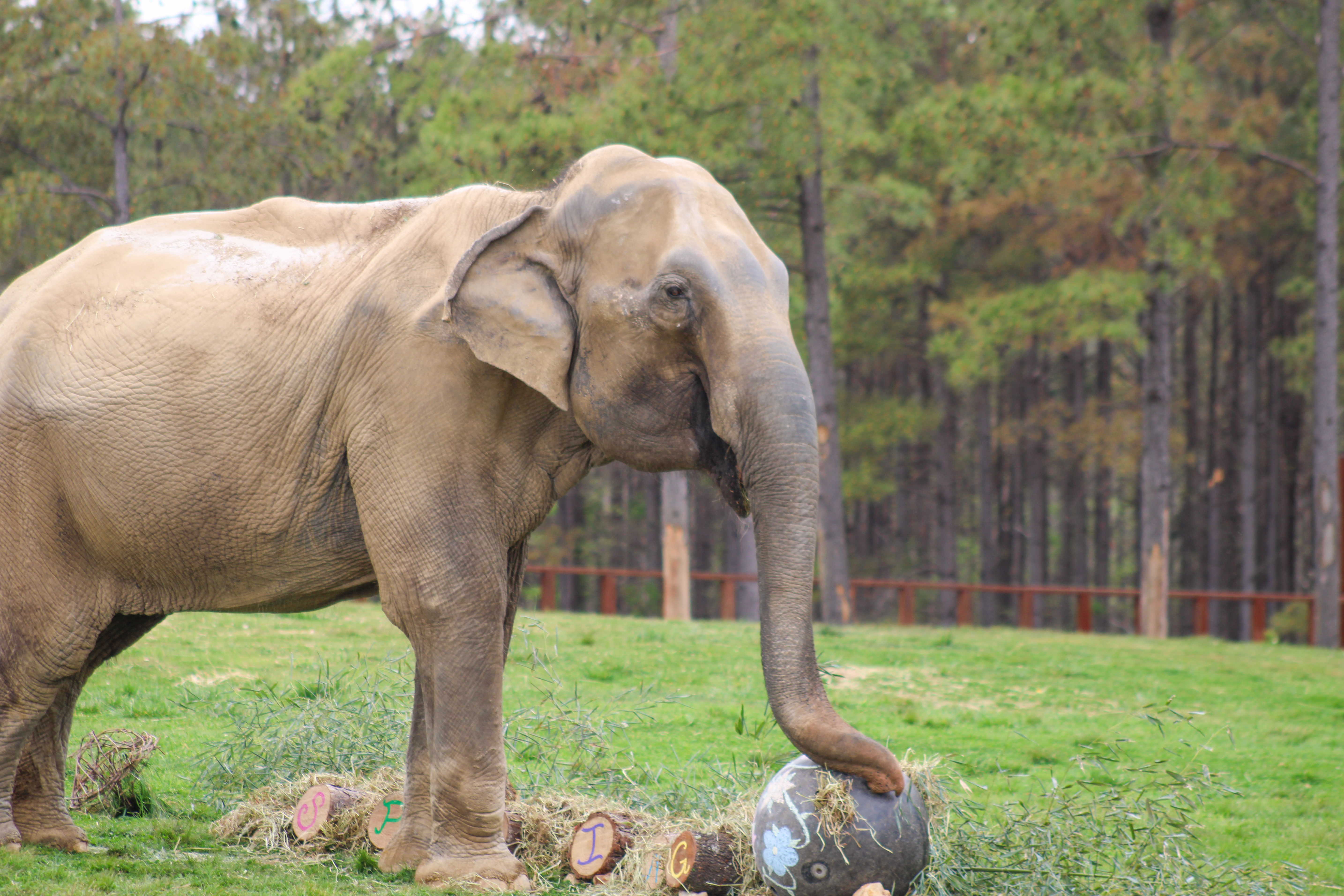
An African elephant eyes a snack at the elephant exhibit at the
Philadelphia Zoo. The nation's oldest zoo has featured elephants
since it opened in 1874. (Photos By Mike Mergen -- Bloomberg News)
He said that just like humans, elephants would rather stay put,
and they do if they can find water, shelter and food.
"Some of this is our own fault. We put up signs at the fence
that say an elephant can walk 50 miles in a day and people then
say they have to walk that far," said Reed. "We make sure
our elephants get exercise, but three, four, five miles is plenty,
we feel."
He said the Sedgwick Zoo in Wichita is building a 3 1/2 -acre elephant
habitat and plans to acquire as many as four more elephants in the
coming years.
The Philadelphia Zoo's Baker said his zoo shipped its chimpanzees
to zoos in St. Louis and Scottsbluff, Neb., a decade ago.
"We didn't think we could care for them correctly. It was
a disappointment for visitors for a while, but then the furor died
down," he said. There are 1,600 animals, many of them exotic
species from all over the world, at the Philadelphia Zoo. "I
know if the elephants go, it will be sad, but we will have the new
big-cat exhibit and many other things to attract people."
Elephants, though, are both an attraction and a sentimental thing
for Reed.
"Our job is to link people to these animals, to know that
their education about them has a global reach," Reed said,
noting that despite great conservation efforts, the population of
African elephants has dwindled from 2 million to 600,000 in the
past 25 years and that there are only 40,000 Asian elephants left.
"My first animal contact was seeing Rosie the elephant at
the Portland, Oregon, zoo when I was 3 1/2 , in 1954. It had a huge
impact, and I know it is why I am in this line of work," he
said. "We've had elephants in circuses, zoos, on television,
with 'Dumbo,' cartoons. Yes, zoos should always update their care,
but they are an umbrella species. People are attracted to give money
and time to conserve them, and in that way conserve the wild environment
around them."