Mongobay.Com
August 15, 2007
Original
Article
Asian elephants don’t carry
photo identification, so scientists from the
Wildlife Conservation Society and India’s
Nature Conservation Foundation are providing
the service free of charge by creating a photographic
archive of individual elephants, which can help
save them as well.
The researchers have developed a unique “photographic
capture-recapture” survey method that identifies
individual male elephants, specifically by the
shape and size of their tusks, ears, and other
features. This in turn can be used to monitor
their survival rates and movement, according
to a new study published in the current issue
of the Journal Animal Conservation (10: 391-399).
“Unlike African elephants
where both males and females have tusks, only
male Asian elephants have valuable tusks, so
they are specifically targeted by poachers,” said
WCS researcher Varun Goswami, the study’s
lead author. “In
light of this fact, just counting all elephants
with generic techniques isn’t enough. Our
new method allows specific tracking of male elephant
population dynamics, so it is a powerful conservation
tool.”
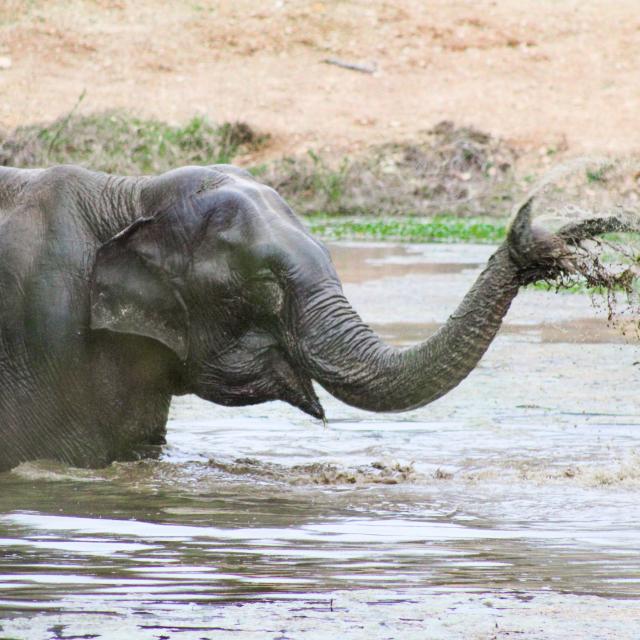
Indian
elephant. Photo credit: Sanjay Gubbi
The new method complements traditional survey
techniques, which can gauge overall elephant
densities and sex ratios at population levels,
but are unable to monitor demographics of male
elephants with a degree of rigor attained by
studies that focus on data from individual animals.
More importantly, such accurate assessments of
male elephants can help conservationists monitor
poaching rates over the long term. Also, elephant
carcasses can be compared with archival photos
to identify individuals and even to aid in law
enforcement efforts.
In addition to poaching, another threat to male
elephants comes from human farmers defending
their food resources from crop-raiders. Recognizing
individual males that are prone to crop-raiding
can inform better management interventions. At
present, exactly how many male elephants engage
in crop-raiding is unknown.
“The rigor of this technique
can help us achieve real conservation success
with the Asian elephants, which are threatened
across their 13 country range,” said Dr.
Ullas Karanth, a co-author of the study who pioneered
the use of the photographic capture-recapture
method to study tigers earlier. “We believe
this method can be expanded to answer other questions
relevant to Asian elephant conservation across
their entire range.”
Related articles
African
elephants get 9-year reprieve
(6/14/2007) African countries have agreed to extend a ban on ivory exports
for another nine years. In a deal reached Wednesday at the meeting of the UN
Convention on International Trade in Endangered Species (CITES) in The Hague,
four African countries will be allowed to sell their ivory stockpiles to raise
funds for conservation and community development efforts. The ivory had been
intercepted from black market transactions and the sale by Botswana, Namibia,
South Africa and Zimbabwe had been previously approved. The four countries
say their elephant populations are increasing thanks to conservation and law
enforcement efforts.
Elephants
respond to calls from friends, not strangers
(6/5/2007) Elephants can distinguish between friendly calls and those of strangers
reports a new study covered in ScienceNOW Daily News. In 2004 Caitlin O'Connell-Rodwell
of Stanford University discovered that elephants use low-frequency, partially
infrasonic ground vibrations to communicate with each other from miles away.
The pachyderms press their trunks against the ground to detect the calls.
Working in collaboration with the Karantaka State Forest Department in Nagarahole
and Bandipur reserves, researchers systematically took more than 2400 photographs
of individual elephants, sampling game roads and waterholes over an 80-day
period. Male elephants in particular were given special treatment, with the
scientists recording data such as tusk length, thickness, angle, arrangement,
as well as other characteristics ear shape, shoulder height, tail length, and
scars. These data revealed some 134 individual male elephants in a population
of 991 elephants, with an adult male/female ratio of 1 to 4.33. The data were
analyzed using advanced ‘open capture-recapture models.’
This is a modified news release from WCS
|