Two Separate Species, African and 
Asian

Conservation?

Information has recently indicated there may actually be a THIRD species of elephants.

MORE INFORMATION ON THE THIRD SPECIES

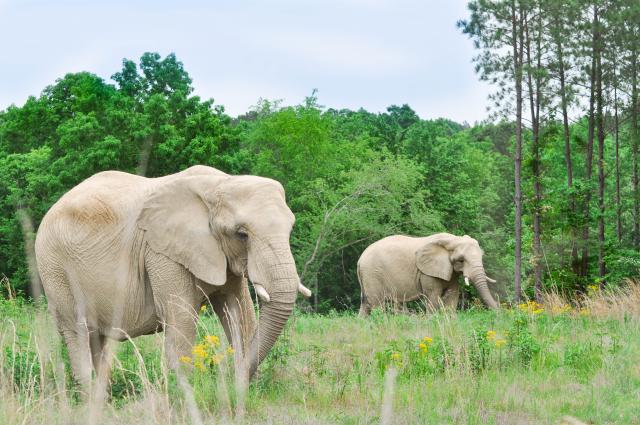
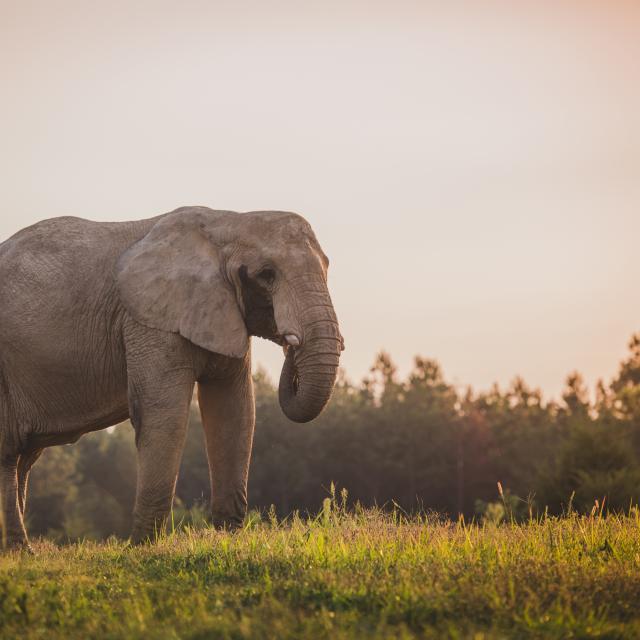
There are several anatomical and behavioral differences between Asian and African elephants and many similarities. Most noticeable is the difference in ears. Africans have huge ears shaped much like the continent of Africa. (One ear from a bull African elephant weighs more than 100 pounds.) Asians, who live in cooler forest areas, have smaller ears. Asians have rounded backs and relatively smooth skin. Africans display a sway back and very wrinkled skin.

Among Asian elephants, only males grow long incisor teeth called tusks, and not all males have them. (This is why ivory poaching has not been a tremendous problem for Asian elephants.) African elephants of both sexes generally (but not always) exhibit tusks.

An Asian elephant trunkThe trunks are also slightly different. Asian elephants have one small finger-like projection at the end of the trunk. African elephants have two "fingers." These "fingers" are very sensitive and make it possible for these huge animals to pick up very small objects. The more than 100,000 muscles in the trunk make it very flexible and strong enough to lift whole trees.

A similarity is in feeding habits. Both species are herbivores-- they consume only plant material. The elephants of the African savanna eat mostly grasses, turning to leaves, twigs, bark, flowers and fruits when the grasses are not available. Asians consume a similar range of plants, including large amounts of bamboo (a fast-growing grass). Within an ecosystem, different species survive by avoiding competition for food. In any area, different animals eat specific things or feed at different times than their neighbors and therefore do not waste precious energy fighting for food. Because elephants developed after (or at the same time as) the perissodactyls (horses) and the ruminants (antelope/giraffe), they had to develop different feeding habits to survive. Elephants, therefore, developed the ability to eat a wide variety of plant materials in addition to grass. This includes the twigs and bark that horses and antelope do not generally eat. There isn't much nutrition in such woody material, but it is available year round and within the elephants' extended reach.

Though they can consume foods other animals usually don't eat, neither species of elephant has an efficient digestive system. Elephants must consume huge amounts of food each day because half of it passes through virtually undigested. This means that both species must move about constantly in search of food, and both are finding less and less space open to them.

Both species of elephant are herd animals living in very definite social structure. Herds are led by a matriarch, usually the oldest female, and are made up of her daughters, sisters, and their offspring. Once they reach puberty, male calves leave the mother's herd and join other young males in bachelor groups. Older males tend to be solitary.

Finally, both Asian and African elephants are highly intelligent and peaceful animals whose continued existence is threatened.


By PAUL RECER AP
Science Writer WASHINGTON (AP) -

Dumbo may have a new cousin. Researchers analyzing genes of African elephants found that the forest and grassland groups are different enough to be considered separate species, which means that three distinct species of elephants exist in the world.

Science has long recognized the clear differences between the African and Asian elephants. The genetic dissimilarity between the forest and the savanna elephants "is like the difference between the lion and the tiger. It is that large," said Jill Pecon-Slattery, a genetic researcher at the National Cancer Institute.

Pecon-Slattery and her co-authors of a study appearing Friday in the journal Science said that based on differences seen in genes collected from 195 African elephants and from seven Asian elephants it is clear that there "should be a species level recognition" for the two African groups.

The African elephant genetic samples were collected over eight years using darts fired into animals in 21 different groups. The darts were designed to punch and hold a small sample of skin from the target animals, then drop to the ground. When the elephants left, the researchers retrieved the darts and recovered bits of skin containing gene samples. The technique was developed to enable researchers trace the origins of illegal ivory. A researcher in Africa, Nicholas Georgiadis of the Mpala Research Center in Kenya, directed the sample collection. The genetic study was conducted by Pecon-Slattery, Alfred Roca and Stephen O'Brien at the National Cancer Institute, one of the National Institutes of Health.

Naturalists have long noted the difference between the rarely seen forest elephant and the grassland, or savanna, elephant in Africa. The savanna elephant, known to scientists as Loxodonta africana, has large ears with ragged edges and curving tusks. It ranges widely in the grassland and bush country of east-central and southern Africa. This is the elephant most commonly seen in zoos and by tourists visiting Africa. The African forest elephant, known as Loxodonta cyclotis, is slightly smaller and has rounded ears. Its tusks are straighter and longer and the ivory has a slightly pink hue, making it highly prized. The forest elephant lives in densely wooded areas of central west Africa. Because of its habitat, it is less commonly seen. The only African forest elephant in captivity is in a zoo in Paris.

The Asian elephant, known as Elephas maximus, has much smaller ears and is widely used as a domestic beast of burden in Asia. Wild Asian elephants are uncommon. Pecon-Slattery said enough genetic difference exists between the Asian and African elephants for them to be in different genera, which means they are more distantly related than are animals that share the same genus. Animals in the same genus can be closely related and still of different species.

The genetic difference between the forest and savanna African elephants is about 58 percent of the genetic difference between the African and Asian elephants, Pecon-Slattery said. She said the two African elephant species are closely enough related that they could mate productively, and the study suggested there were hybrids of the two species in the distant past. "It has occurred, but not that often," she said. "But this doesn't destroy the uniqueness of the original species."

Samuel Wasser, a conservation biologist at the University of Washington, said he and his colleagues have conducted an even more extensive genetic survey of the elephant, and their conclusion agrees that the African animals are of two distinct species. Wasser, who has conducted extensive research in Tanzania, said the African elephant continues to be under intense poaching pressure. He said some studies have suggested the population has dropped from about 1.3 million the 1980s to about a half-million now. The forest elephant is entering a new phase of poaching danger, Wasser said, because logging and road building have penetrated its dense jungle home and allow poachers easier access. Wasser said the illegal sale of the distinctive pink-hued ivory and meat from the forest elephant have both increased in recent years. ---


From time to time articles appear online which we would like to recommend to people who visit our site. Some of these appear below. Please remember to hit the "back" navigation button on your web browser to return to the Sanctuary Website.

A report from Stanford University about elephants' early warning system, March 14, 2001

The Smithsonian Magazine, Sept. 1998

CNN report (April 1996) on Barbara's arrival at the Sanctuary

line
Home | Our Mission | About the Sanctuary | Search | EleCam
All About Elephants | You Can Help | Our Girls Gift Shop | Photo Gallery
Meet the Elephants | Sanctuary News | The Curriculum
Trunklines Newsletter | Site Map | Contact Us