New York Times
Feb. 7, 2006
By Joseph Berger
Original
Article
Elephants have never lost the capacity to astonish
and delight. But in New York City in the not-so-distant future,
they will not be doing their astonishing and delighting at a zoo.

James
Estrin/The New York Times
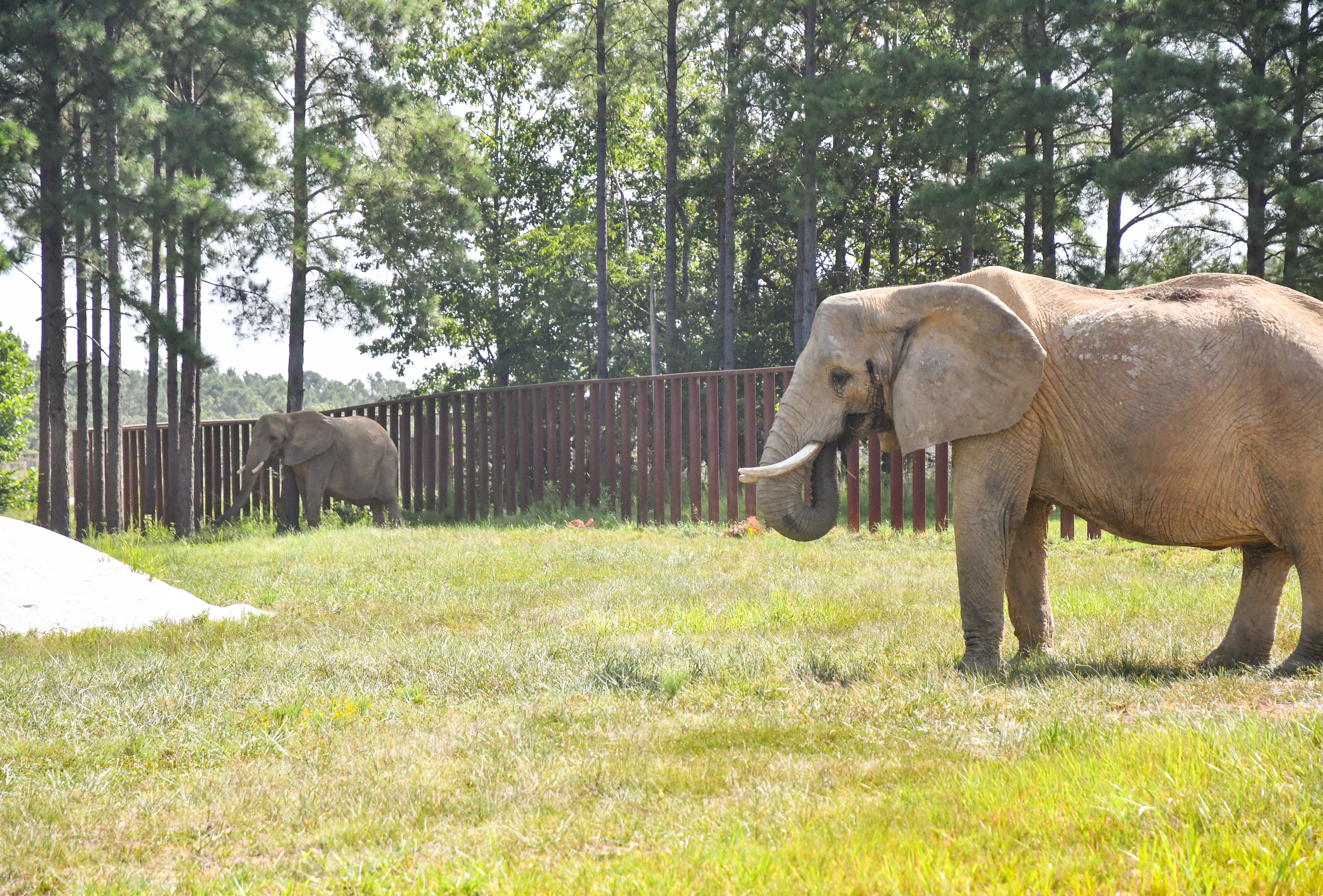
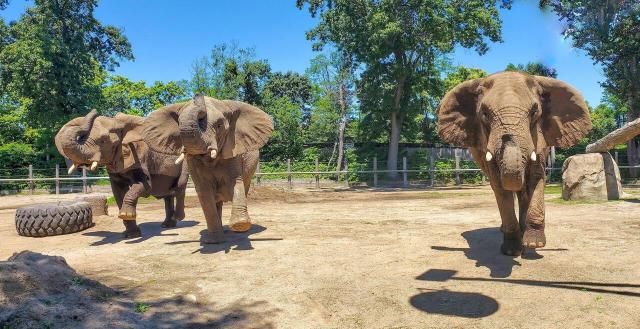
Maxine, left, and Patty, who are in their mid-30's, roamed their two-acre corral
Monday at the Bronx Zoo.
The Bronx Zoo, the only zoo left in the city that keeps elephants,
said yesterday that it planned to shut down its exhibit after the
death of two of its three elephants, or even one.
The current generation of children need not despair: The zoo's
three elephants — Patty, Maxine and Happy — are in their
mid-30's and could live for decades more. But if one elephant dies,
the remaining two may not get along. And if two die, officials say
it would be inhumane to sustain an exhibit with a single elephant.
In either case, the zoo will not replenish the group. And then,
except for the occasional circus visit, the five boroughs will be
without a resident elephant for the first time in more than 100
years.
"I'm happy for the elephants. I'm sad for me," said Peter
Rhall of Valley Stream, N.Y., as he clutched his 2-year-old daughter
Sophie in yesterday's frigid wind at one of the zoo's entrances.
It's a shift occurring around the country. While once every zoo
worthy of the title would boast an elephant, facilities in San Francisco,
Detroit, Santa Barbara, Calif., and Lincoln Park in Chicago have
either closed their elephant exhibits or decided to phase them out.
The Philadelphia Zoo's board, citing financial reasons, has abandoned
plans to build a $22 million, 2.5-acre savanna for its four elephants,
and is mulling what it will do about a current corral that critics
have called cramped, said Andrew Baker, senior vice president for
animal programs. In New York, the Central Park and Prospect Park
Zoos stopped exhibiting elephants in the 1980's.
The reasons behind the shift are complex and involve both the
distinctive personality traits of pachyderms and America's changing
standards when it comes to confining animals.
Keeping elephants happy in captivity can be a delicate balancing
act, said Steven Sanderson, president and chief executive of the
Wildlife Conservation Society, which operates the Bronx, Central
Park, Prospect Park and Queens Zoos as well as the New York Aquarium.
Elephants prefer living in herds at least a half-dozen strong, need
a lot of space to roam, are prone to arthritis and foot diseases,
and can become distressed when new elephants are introduced into
their enclosures.
The Bronx Zoo, Mr. Sanderson said, has a two-acre corral in which
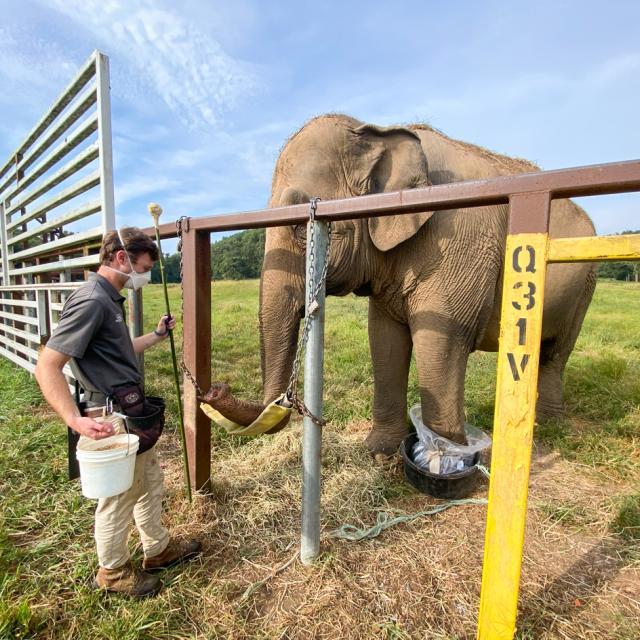
the elephants can move about, and its zookeepers monitor the stumpy
feet of its elephants daily, but he would prefer to give them more
company. Elephants may show their discomfort with a new arrival
by the equivalent of a hunger strike.
"These are really social animals built around a matriarchy," he
said. "The senior females have a lot to say about the size
of the group, reproduction, etc. They do a lot of communication
and are not open to newcomers."
The zoo has kept elephants for more than a hundred years. In 2002,
Tuss, the matriarch and pot-stirrer of its Asian elephant group,
died in her 50's, leaving the other elephants without a leader and
an institutional memory. Last week a fourth female elephant, Samuel
R., who had been named after a benefactor's father, died at 14 of
kidney failure. Rather than replenish the herd, the zoo decided
to close the exhibit.
Breeding elephants in captivity has proved difficult; not even
artificial insemination or the introduction of a bull has been helpful.
The Bronx Zoo has not had a live birth in more than 20 years. Laws
intended to clamp down on the illegal trade in animals have also
made it more cumbersome for zoos to import elephants from the wild.
Given those factors, Mr. Sanderson said, the society would rather
steer its money toward preserving elephants in the wild in Africa
and Asia, where it already spends $2 million a year.
Animal-rights groups like People for the Ethical Treatment of Animals
have been trying for years to close down zoos. "PETA opposes
captivity in zoos for all wild animals. However, there can be no
doubt that some species are less suited for captivity," said
Lisa Wathne, a specialist in captive exotic animals for PETA. "Elephants
are suffering horribly."
She said that half of the 45 elephants that have died since 2000
in the 210 accredited American zoos did not live to reach 40.
But Mr. Sanderson denied that animal activists played a role in
the decision. "We were on this issue 20 years ago," he
said.
Yesterday morning, Patty and Maxine (yes, they and a third elephant
who died, LaVerne, were named after the Andrews Sisters, though
Maxine's name does not quite match her namesake's, Maxene) lumbered
around their dirt pen. Patty, roughly 10,000 pounds and identifiable
by her smaller head, scratched the hide of her skull against a tree
trunk while Maxine, at 11,000 pounds, sprayed dirt on her back.
Both swallowed apples and bananas that Joseph Mahoney, the zoo's
supervisor of mammals, lobbed at them.
Mr. Mahoney, who has worked with elephants for 25 years, has gotten
to know their personalities. "Patty is more of a planner, and
Maxine carries out the plan," Mr. Mahoney said, looking sad. "Patty
will lead Maxine to a log, and Maxine will push it around."