New York Times Magazine
October 7, 2006
By Charles
Siebert
Original Article
Attacks
by elephants on villages, people and
other animals are on the rise. Some researchers are pointing to
a species-wide trauma and the fraying of the fabric of pachyderm
society
‘We’re not going anywhere,” my driver, Nelson
Okello, whispered to me one morning this
past June, the two of us sitting in the front seat of a jeep just
after dawn in Queen Elizabeth National Park in southwestern Uganda.
We’d originally stopped
to observe what appeared to be a lone
bull elephant grazing in a patch of tall savanna grasses off to
our left. More than one “rogue” crossed
our path that morning — a young male elephant that has made
an overly strong power play against the
dominant male of his herd and been banished,
sometimes permanently. This elephant, however, soon proved to be
not a rogue but part of a cast of at least 30. The ground vibrations
registered just before the emergence of the herd from the surrounding
trees and brush. We sat there watching the elephants cross the road
before us, seeming, for all their heft, so light on their feet,
soundlessly plying the wind-swept savanna grasses like land whales
adrift above the floor of an ancient, waterless sea.
Photo:
Andres Serrano for The New York Times
Then, from behind a thicket of acacia trees
directly off our front left bumper, a huge female emerged — “the matriarch,” Okello
said softly. There was a small calf beneath her, freely foraging
and knocking about within the secure cribbing of four massive legs.
Acacia leaves are an elephant’s favorite food, and as the
calf set to work on some low branches,
the matriarch stood guard, her vast back flank blocking the road,
the rest of the herd milling about in the brush a short distance
away.
Photo:
Andres Serrano for The New York Times
After 15 minutes or so, Okello started inching
the jeep forward, revving the engine,
trying to make us sound as beastly as possible. The matriarch, however,
was having none of it, holding her ground, the fierce white of her
eyes as bright as that of her tusks. Although I pretty much knew
the answer, I asked Okello if he was considering trying to drive
around. “No,” he said, raising an index
finger for emphasis. “She’ll charge. We should stay
right here.”
I’d have considered it a wise policy even at a more peaceable
juncture in the course of human-elephant relations. In recent years,
however, those relations have become markedly more bellicose. Just
two days before I arrived, a woman was killed by an elephant in
Kazinga, a fishing village nearby. Two months earlier, a man was
fatally gored by a young male elephant at the northern edge of the
park, near the village of Katwe. African elephants use their long
tusks to forage through dense jungle brush. They’ve also been
known to wield them, however, with the
ceremonious flash and precision of gladiators, pinning down a victim
with one knee in order to deliver the decisive thrust. Okello told
me that a young Indian tourist was killed in this fashion two years
ago in Murchison Falls National Park, just north of where we were.
These were not isolated incidents. All across
Africa, India and parts of Southeast Asia, from within
and around whatever patches and corridors
of their natural habitat remain, elephants have been striking
out, destroying villages and crops, attacking and killing human
beings. In fact, these attacks have become so commonplace that
a whole new statistical category, known as Human-Elephant Conflict,
or H.E.C., was created by elephant researchers in the mid-1990’s
to monitor the problem. In the Indian
state Jharkhand near the western border of Bangladesh, 300 people
were killed by elephants between 2000 and 2004. In the past 12
years, elephants have killed 605 people in Assam, a state in northeastern
India, 239 of them since 2001; 265 elephants have died in that
same period, the majority of them as a result of retaliation by
angry villagers, who have used everything from poison-tipped arrows
to laced food to exact their revenge. In Africa, reports of human-elephant
conflicts appear almost daily, from Zambia to Tanzania, from Uganda
to Sierra Leone, where 300 villagers evacuated their homes last
year because of unprovoked elephant attacks.
Still, it is not only the increasing number
of these incidents that is causing alarm but also the singular
perversity — for
want of a less anthropocentric term — of recent elephant aggression.
Since the early 1990’s, for example, young male elephants
in Pilanesberg National Park and the Hluhluwe-Umfolozi Game Reserve
in South Africa have been raping and killing rhinoceroses; this
abnormal behavior, according to a 2001 study in the journal Pachyderm,
has been reported in “a number of reserves” in the region.
In July of last year, officials in Pilanesberg
shot three young male elephants who were responsible for the killings
of 63 rhinos, as well as attacks on people in safari vehicles. In
Addo Elephant National Park, also in South Africa, up to 90 percent
of male elephant deaths are now attributable to other male elephants,
compared with a rate of 6 percent in more stable elephant communities.
In a coming book on this phenomenon, Gay
Bradshaw, a psychologist at the environmental-sciences program
at Oregon State University, notes that in India, where the elephant
has long been regarded as a deity, a recent headline in a leading
newspaper warned, “To
Avoid Confrontation, Don’t Worship Elephants.” “Everybody
pretty much agrees that the relationship between elephants and people
has dramatically changed,” Bradshaw told me recently. “What
we are seeing today is extraordinary. Where for centuries humans
and elephants lived in relative peaceful coexistence, there is now
hostility and violence. Now, I use the term ‘violence’ because
of the intentionality associated with
it, both in the aggression of humans and, at times, the recently
observed behavior of elephants.”
For a number of biologists and ethologists
who have spent their careers studying elephant behavior, the attacks
have become so abnormal in both number and kind that they can
no longer be attributed entirely to the customary factors. Typically,
elephant researchers have cited, as a cause of aggression, the
high levels of testosterone in newly matured male elephants or
the competition for land and resources between elephants and humans.
But in “Elephant Breakdown,” a
2005 essay in the journal Nature, Bradshaw and several colleagues
argued that today’s elephant populations are suffering from
a form of chronic stress, a kind of species-wide
trauma. Decades of poaching and culling and habitat loss, they claim,
have so disrupted the intricate web of familial and societal relations
by which young elephants have traditionally been raised in the wild,
and by which established elephant herds are governed, that what
we are now witnessing is nothing less than a precipitous collapse
of elephant culture.
It has long been apparent that every large, land-based animal on
this planet is ultimately fighting a
losing battle with humankind. And yet entirely befitting of an animal
with such a highly developed sensibility, a deep-rooted sense of
family and, yes, such a good long-term memory, the elephant is not
going out quietly. It is not leaving without making some kind of
statement, one to which scientists from a variety of disciplines,
including human psychology, are now beginning to pay close attention.
Once the matriarch and her calf were a comfortable
distance from us that morning, Okello and I made the 20-minute
drive to Kyambura, a village at the far southeastern edge of the
park. Back in 2003, Kyambura was reportedly the site of the very
sort of sudden, unprovoked elephant attack I’d been hearing
about. According to an account of the event in the magazine New
Scientist, a number of huts and fields were trampled, and the
townspeople were afraid to venture out to surrounding villages,
either by foot or on their bikes, because elephants were regularly
blocking the road and charging out at those who tried to pass.
Park officials from the Uganda Wildlife Authority
with whom I tried to discuss the incident were reluctant to talk
about it or any of the recent killings by elephants in the area.
Eco-tourism is one of Uganda’s major sources of income, and the elephant and
other wildlife stocks of Queen Elizabeth National Park are only
just now beginning to recover from years of virtually unchecked
poaching and habitat destruction. Tom Okello, the chief game warden
at the park (and no relation to my driver), and Margaret Driciru,
Queen Elizabeth’s chief veterinarian, each told me that they
weren’t aware of the attack in Kyambura. When I mentioned
it to the executive director of the wildlife authority, Moses Mapesa,
upon my initial arrival in the capital city, Kampala, he eventually
admitted that it did happen, but he claimed that it was not nearly
as recent as reported. “That was 14 years ago,” he said. “We
have seen aggressive behavior from elephants, but that’s a
story of the past.”
Kyambura did look, upon our arrival, much
like every other small Ugandan farming community I’d passed through on my visit.
Lush fields of banana trees, millet and maize framed a small town
center of pastel-colored single-story cement buildings with corrugated-tin
roofs. People sat on stoops out front in the available shade. Bicyclers
bore preposterously outsize loads of bananas, firewood and five-gallon
water jugs on their fenders and handlebars. Contrary to what I had
read, the bicycle traffic along the road in and out of Kyambura
didn’t seem impaired in the slightest.
But when Okello and I asked a shopkeeper named Ibrah Byamukama
about elephant attacks, he immediately nodded and pointed to a patch
of maize and millet fields just up the road, along the edges of
the surrounding Maramagambo Forest. He confirmed that a small group
of elephants charged out one morning two years earlier, trampled
the fields and nearby gardens, knocked down a few huts and then
left. He then pointed to a long orange gash in the earth between
the planted fields and the forest: a 15-foot-deep, 25-foot-wide
trench that had been dug by the wildlife authority around the perimeter
of Kyambura in an attempt to keep the elephants at bay. On the way
out of town, Okello and I took a closer look at the trench. It was
filled with stacks of thorny shrubs for good measure.
“The people are still worried,” Byamukama said, shaking
his head. “The elephants are just becoming more destructive.
I don’t know why.”
Three years ago, Gay Bradshaw, then working on her graduate degree
in psychology at the Pacifica Graduate Institute outside Santa Barbara,
Calif., began wondering much the same thing: was the extraordinary
behavior of elephants in Africa and Asia signaling a breaking point?
With the assistance of several established African-elephant researchers,
including Daphne Sheldrick and Cynthia Moss, and with the help of
Allan Schore, an expert on human trauma disorders at the department
of psychiatry and biobehavioral sciences at U.C.L.A., Bradshaw sought
to combine traditional research into elephant behavior with insights
about trauma drawn from human neuroscience. Using the few remaining
relatively stable elephant herds in places like Amboseli National
Park in Kenya, as control groups, Bradshaw and her colleagues analyzed
the far more fractious populations found in places like Pilanesberg
in South Africa and Queen Elizabeth National Park in Uganda. What
emerged was a portrait of pervasive pachyderm dysfunction.
Elephants, when left to their own devices, are profoundly social
creatures. A herd of them is, in essence, one incomprehensibly massive
elephant: a somewhat loosely bound and yet intricately interconnected,
tensile organism. Young elephants are raised within an extended,
multitiered network of doting female caregivers that includes the
birth mother, grandmothers, aunts and friends. These relations are
maintained over a life span as long as 70 years. Studies of established
herds have shown that young elephants stay within 15 feet of their
mothers for nearly all of their first eight years of life, after
which young females are socialized into the matriarchal network,
while young males go off for a time into an all-male social group
before coming back into the fold as mature adults.
When an elephant dies, its family members
engage in intense mourning and burial rituals, conducting weeklong
vigils over the body, carefully covering it with earth and brush,
revisiting the bones for years afterward, caressing the bones
with their trunks, often taking turns rubbing their trunks along
the teeth of a skull’s lower jaw,
the way living elephants do in greeting. If harm comes to a member
of an elephant group, all the other elephants are aware of it. This
sense of cohesion is further enforced by the elaborate communication
system that elephants use. In close proximity they employ a range
of vocalizations, from low-frequency rumbles to higher-pitched screams
and trumpets, along with a variety of visual signals, from the waving
of their trunks to subtle anglings of the head, body, feet and tail.
When communicating over long distances — in order to pass
along, for example, news about imminent threats, a sudden change
of plans or, of the utmost importance to elephants, the death of
a community member — they use patterns of subsonic vibrations
that are felt as far as several miles
away by exquisitely tuned sensors in the padding of their feet.
This fabric of elephant society, Bradshaw
and her colleagues concluded, had effectively been frayed by years
of habitat loss and poaching, along with systematic culling by
government agencies to control elephant numbers and translocations
of herds to different habitats. The number of older matriarchs
and female caregivers (or “allomothers”)
had drastically fallen, as had the number of elder bulls, who play
a significant role in keeping younger males in line. In parts of
Zambia and Tanzania, a number of the elephant groups studied contained
no adult females whatsoever. In Uganda, herds were often found to
be “semipermanent aggregations,” as a paper written
by Bradshaw describes them, with many
females between the ages of 15 and 25 having no familial associations.
As a result of such social upheaval, calves
are now being born to and raised by ever younger and inexperienced
mothers. Young orphaned elephants, meanwhile, that have witnessed
the death of a parent at the hands of poachers are coming of age
in the absence of the support system that defines traditional
elephant life. “The
loss of elephants elders,” Bradshaw told me, “and the
traumatic experience of witnessing the
massacres of their family, impairs normal brain and behavior development
in young elephants.”
What Bradshaw and her colleagues describe
would seem to be an extreme form of anthropocentric conjecture
if the evidence that they’ve
compiled from various elephant resesarchers, even on the strictly
observational level, wasn’t so compelling. The elephants of
decimated herds, especially orphans who’ve watched the death
of their parents and elders from poaching and culling, exhibit behavior
typically associated with post-traumatic stress disorder and other
trauma-related disorders in humans: abnormal startle response, unpredictable
asocial behavior, inattentive mothering and hyperaggression. Studies
of the various assaults on the rhinos in South Africa, meanwhile,
have determined that the perpetrators were in all cases adolescent
males that had witnessed their families being shot down in cullings.
It was common for these elephants to have been tethered to the bodies
of their dead and dying relatives until they could be rounded up
for translocation to, as Bradshaw and Schore describe them, “locales
lacking traditional social hierarchy
of older bulls and intact natal family structures.”
In fact, even the relatively few attempts
that park officials have made to restore parts of the social fabric
of elephant society have lent substance to the elephant-breakdown
theory. When South African park rangers recently introduced a
number of older bull elephants into several destabilized elephant
herds in Pilanesburg and Addo, the wayward behavior — including unusually premature hormonal
changes among the adolescent elephants — abated.
But according to Bradshaw and her colleagues, the various pieces
of the elephant-trauma puzzle really come together at the level
of neuroscience, or what might be called the physiology of psychology,
by which scientists can now map the marred neuronal fields, snapped
synaptic bridges and crooked chemical streams of an embattled psyche.
Though most scientific knowledge of trauma is still understood through
research on human subjects, neural studies of elephants are now
under way. (The first functional M.R.I. scan of an elephant brain,
taken this year, revealed, perhaps not surprisingly, a huge hippocampus,
a seat of memory in the mammalian brain, as well as a prominent
structure in the limbic system, which processes emotions.) Allan
Schore, the U.C.L.A. psychologist and neuroscientist who for the
past 15 years has focused his research on early human brain development
and the negative impact of trauma on it, recently wrote two articles
with Bradshaw on the stress-related neurobiological underpinnings
of current abnormal elephant behavior.
“We know that these mechanisms cut across species,” Schore
told me. “In the first years of humans as well as elephants,
development of the emotional brain is
impacted by these attachment mechanisms, by the interaction that
the infant has with the primary caregiver, especially the mother.
When these early experiences go in a positive way, it leads to greater
resilience in things like affect regulation, stress regulation,
social communication and empathy. But when these early experiences
go awry in cases of abuse and neglect, there is a literal thinning
down of the essential circuits in the brain, especially in the emotion-processing
areas.”
For Bradshaw, these continuities between
human and elephant brains resonate far outside the field of neuroscience. “Elephants
are suffering and behaving in the same ways that we recognize in
ourselves as a result of violence,” she told me. “Elephant
behavior is entirely congruent with what we know about humans and
other mammals. Except perhaps for a few specific features, brain
organization and early development of elephants and humans are extremely
similar. That’s not news. What is news is when you start asking,
What does this mean beyond the science? How do we respond to the
fact that we are causing other species like elephants to psychologically
break down? In a way, it’s not so much a cognitive or imaginative
leap anymore as it is a political one.”
Eve Abe says that in her mind, she made that
leap before she ever left her mother’s womb. An animal ethologist and wildlife-management
consultant now based in London, Abe (pronounced AH-bay) grew up
in northern Uganda. After several years of studying elephants in
Queen Elizabeth National Park, where decades of poaching had drastically
reduced the herds, Abe received her doctorate at Cambridge University
in 1994 for work detailing the parallels she saw between the plight
of Uganda’s orphaned male elephants and the young male orphans
of her own people, the Acholi, whose families and villages have
been decimated by years of civil war. It’s work she proudly
proclaims to be not only “the ultimate act of anthropomorphism” but
also what she was destined to do.
“My very first encounter with an elephant was a fetal one,” Abe
told me in June in London as the two of us sipped tea at a cafe
in Paddington Station. I was given Abe’s contact numbers earlier
in the spring by Bradshaw, who is currently
working with Abe to build a community center in Uganda to help both
elephants and humans in their recovery from violence. For more than
a month before my departure from New York, I had been trying without
luck to arrange with the British Home Office for Abe, who is still
waiting for permanent residence status in England, to travel with
me to Uganda as my guide through Queen Elizabeth National Park without
fear of her being denied re-entry to England. She was to accompany
me that day right up to the departure gate at Heathrow, the two
of us hoping (in vain, as it turned out) for a last-minute call
that would have given her leave to use the ticket I was holding
for her in my bag.
“My dad was a conservationist and a teacher,” explained
Abe, a tall, elegant woman with a trilling, nearly girlish voice. “He
was always out in the parks. One of my aunts tells this story about
us passing through Murchison park one day. My dad was driving. My
uncle was in the front seat. In the back were my aunt and my mom,
who was very pregnant with me. They suddenly came upon this huge
herd of elephants on the road, and the elephants just stopped. So
my dad stopped. He knew about animals. The elephants just stood
there, then they started walking around the car, and looking into
the car. Finally, they walked off. But my father didn’t start
the car then. He waited there. After
an hour or more, a huge female came back out onto the road, right
in front of the car. It reared up and trumpeted so loudly, then
followed the rest of the herd back into the bush. A few days later,
when my mom got home, I was born.”
Abe began her studies in Queen Elizabeth
National Park in 1982, as an undergraduate at Makerere University
in Kampala, shortly after she and her family, who’d been living for years as refugees
in Kenya to escape the brutal violence in Uganda under the dictatorship
of Idi Amin, returned home in the wake of Amin’s ouster in
1979. Abe told me that when she first arrived at the park, there
were fewer than 150 elephants remaining from an original population
of nearly 4,000. The bulk of the decimation occurred during the
war with Tanzania that led to Amin’s overthrow: soldiers from
both armies grabbed all the ivory they could get their hands on — and
did so with such cravenness that the word “poaching” seems
woefully inadequate. “Normally when you say ‘poaching,’ ” Abe
said, “you think of people shooting one or two and going off.
But this was war. They’d just throw hand grenades at the elephants,
bring whole families down and cut out
the ivory. I call that mass destruction.”
The last elephant survivors of Queen Elizabeth
National Park, Abe said, never left one another’s side. They kept in a tight
bunch, moving as one. Only one elderly female remained; Abe estimated
her to be at least 62. It was this matriarch who first gathered
the survivors together from their various hideouts on the park’s
forested fringes and then led them back out as one group into open
savanna. Until her death in the early 90’s, the old female
held the group together, the population all the while slowly beginning
to rebound. In her yet-to-be-completed memoir, “My Elephants
and My People,” Abe writes of the prominence of the matriarch
in Acholi society; she named the park’s matriarchal elephant
savior Lady Irene, after her own mother. “It took that core
group of survivors in the park about five or six years,” Abe
told me, “before I started seeing whole new family units emerge
and begin to split off and go their own
way.”
In 1986, Abe’s family was forced to flee the country again.
Violence against Uganda’s people and elephants never completely
abated after Amin’s regime collapsed, and it drastically worsened
in the course of the full-fledged war that developed between government
forces and the rebel Lord’s Resistance Army. For years, that
army’s leader, Joseph Kony, routinely “recruited” from
Acholi villages, killing the parents of young males before their
eyes, or sometimes having them do the killings themselves, before
pressing them into service as child soldiers. The Lord’s Resistance
Army has by now been largely defeated, but Kony, who is wanted by
the International Criminal Court for numerous crimes against humanity,
has hidden with what remains of his army in the mountains of Murchison
Falls National Park, and more recently in Garamba National Park
in northern Congo, where poaching by the Lord’s Resistance
Army has continued to orphan more elephants.
“I started looking again at what has happened among the Acholi
and the elephants,” Abe told me. “I saw that it is an
absolute coincidence between the two. You know we used to have villages.
We still don’t have villages. There are over 200 displaced
people’s camps in present-day northern Uganda. Everybody lives
now within these camps, and there are no more elders. The elders
were systematically eliminated. The first batch of elimination was
during Amin’s time, and that set the stage for the later destruction
of northern Uganda. We are among the lucky few, because my mom and
dad managed to escape. But the families there are just broken. I
know many of them. Displaced people are living in our home now.
My mother said let them have it. All these kids who have grown up
with their parents killed — no fathers, no mothers, only children
looking after them. They don’t go to schools. They have no
schools, no hospitals. No infrastructure. They form these roaming,
violent, destructive bands. It’s the same thing that happens
with the elephants. Just like the male
war orphans, they are wild, completely lost.”
On the ride from Paddington that afternoon
out to Heathrow, where I would catch a flight to Uganda, Abe told
me that the parallel between the plight of Ugandans and their
elephants was in many ways too close for her to see at first.
It was only after she moved to London that she had what was, in
a sense, her first full, adult recognition of the entwinement
between human and elephant that she says she long ago felt in
her mother’s womb.
“I remember when I first was working on my doctorate,” she
said. “I mentioned that I was doing this parallel once to
a prominent scientist in Kenya. He looked amazed. He said, ‘How
come nobody has made this connection before?’ I told him because
it hadn’t happened this way to anyone else’s tribe before.
To me it’s something I see so clearly. Most people are scared
of showing that kind of anthropomorphism. But coming from me it
doesn’t sound like I’m inventing something. It’s
there. People know it’s there. Some might think that the way
I describe the elephant attacks makes
the animals look like people. But people are animals.”
Shortly after my return from Uganda, I went
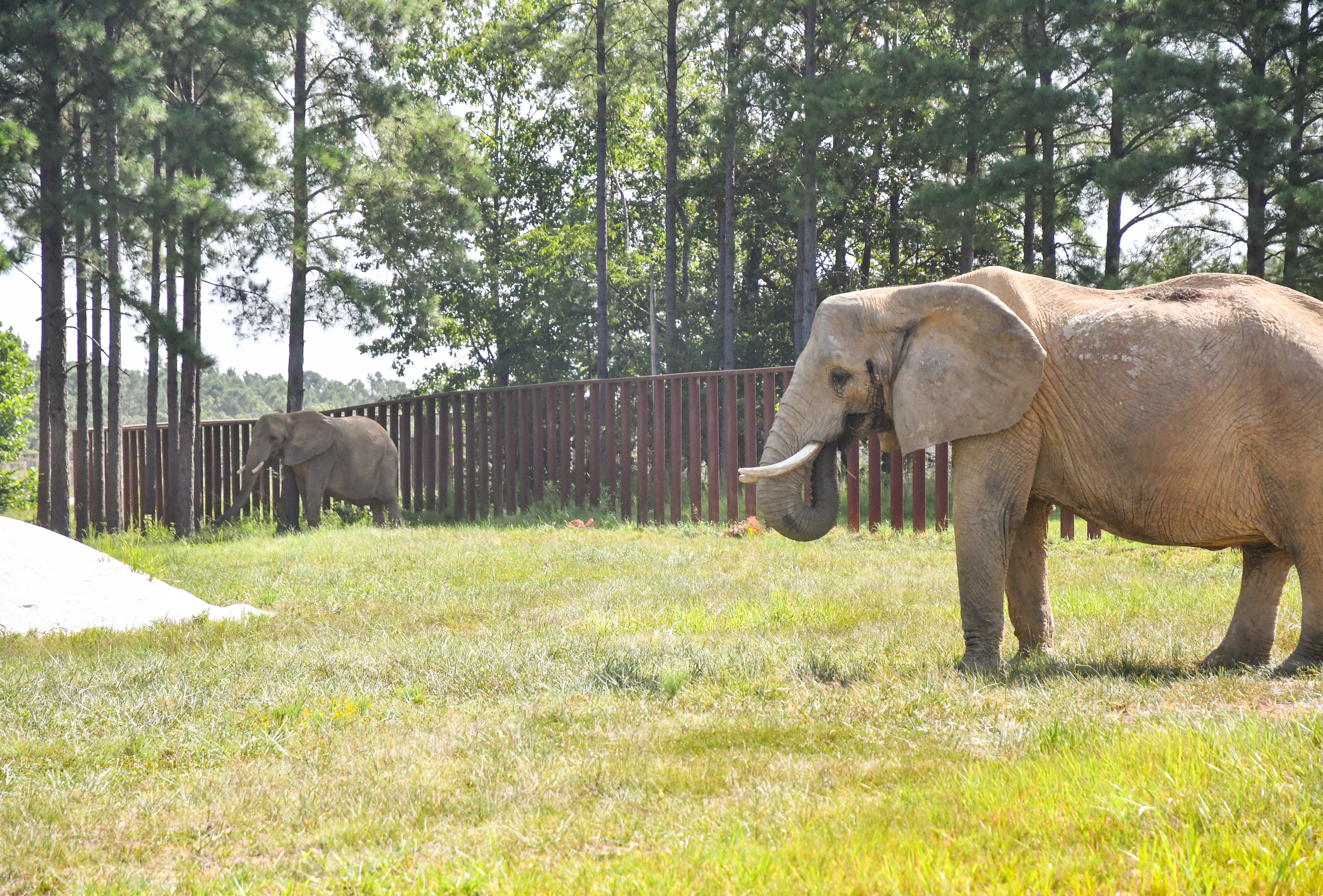
to visit the Elephant Sanctuary in Tennessee, a 2,700-acre rehabilitation
center and retirement facility situated in the state’s verdant, low-rolling southern
hill country. The sanctuary is a kind of asylum for some of the
more emotionally and psychologically disturbed former zoo and circus
elephants in the United States — cases so bad that the people
who profited from them were eager to
let them go. Given that elephants in the wild are now exhibiting
aberrant behaviors that were long observed in captive elephants,
it perhaps follows that a positive working model for how to ameliorate
the effects of elephant breakdown can be found in captivity.
Of the 19 current residents of the sanctuary,
perhaps the biggest hard-luck story was that of a 40-year-old,
five-ton Asian elephant named Misty. Originally captured as a
calf in India in 1966, Misty spent her first decade in captivity
with a number of American circuses and finally ended up in the
early 80’s at a wild-animal attraction
known as Lion Country Safari in Irvine, Calif. It was there, on
the afternoon of July 25, 1983, that Misty, one of four performing
elephants at Lion Country Safari that summer, somehow managed to
break free of her chains and began madly dashing about the park,
looking to make an escape. When one of the park’s zoologists
tried to corner and contain her, Misty
killed him with one swipe of her trunk.
There are, in the long, checkered history
of human-elephant relations, countless stories of lethal elephantine
assaults, and almost invariably of some gruesomely outsize, animalistic
form of retribution exacted by us. It was in the very state of
Tennessee, back in September 1916, that another five-ton Asian
circus elephant, Mary, was impounded by a local sheriff for the
killing of a young hotel janitor who’d
been hired to mind Mary during a stopover
in the northeast Tennessee town of Kingsport. The janitor had
apparently taken Mary for a swim at a local pond, where, according
to witnesses, he poked her behind the left ear with a metal hook
just as she was reaching for a piece of floating watermelon rind.
Enraged, Mary turned, swiftly snatched him up with her trunk,
dashed him against a refreshment stand and then smashed his head
with her foot.
With cries from the townspeople to “Kill the elephant!” and
threats from nearby town leaders to bar the circus if “Murderous
Mary,” as newspapers quickly dubbed her, remained a part of
the show, the circus’s owner, Charlie Sparks, knew he had
to do something to appease the public’s blood lust and save
his business. Among the penalties he is said to have contemplated
was electrocution, a ghastly precedent for which had been set 13
years earlier, on the grounds of the nearly completed Luna Park
in Coney Island. A longtime circus elephant named Topsy, who’d
killed three trainers in as many years — the last one after
he tried to feed her a lighted cigarette — would become the
largest and most prominent victim of Thomas Edison, the father of
direct-current electricity, who had publicly electrocuted a number
of animals at that time using his rival George Westinghouse’s
alternating current, in hopes of discrediting
it as being too dangerous.
Sparks ultimately decided to have Mary hanged
and shipped her by train to the nearby town of Erwin, Tenn., where
more than 2,500 people gathered at the local rail yard for her
execution. Dozens of children are said to have run off screaming
in terror when the chain that was suspended from a huge industrial
crane snapped, leaving Mary writhing on the ground with a broken
hip. A local rail worker promptly clambered up Mary’s bulk
and secured a heavier chain for a second, successful hoisting.
Misty’s fate in the early 80’s,
by contrast, seems a triumph of modern humanism. Banished, after
the Lion Safari killing, to the Hawthorn Corporation, a company
in Illinois that trains and leases elephants and tigers to circuses,
she would continue to lash out at a number of her trainers over
the years. But when Hawthorn was convicted of numerous violations
of the Animal Welfare Act in 2003, the company agreed to relinquish
custody of Misty to the Elephant Sanctuary. She was loaded onto
a trailer transport on the morning of Nov. 17, 2004, and even
then managed to get away with one final shot at the last in her
long line of captors.
“The details are kind of sketchy,” Carol Buckley, a
founder of the Elephant Sanctuary, said to me one afternoon in July,
the two of us pulling up on her all-terrain four-wheeler to a large
grassy enclosure where an extremely docile and contented-looking
Misty, trunk high, ears flapping, waited to greet us. “Hawthorn’s
owner was trying to get her to stretch out so he could remove her
leg chains before loading her on the trailer. At one point he prodded
her with a bull hook, and she just knocked him down with a swipe
of her trunk. But we’ve seen none of that since she’s
been here. She’s as sweet as can be. You’d never know
that this elephant killed anybody.”
In the course of her nearly two years at
the Elephant Sanctuary — much
of it spent in quarantine while undergoing daily treatment for tuberculosis — Misty
has also been in therapy, as in psychotherapy.
Wild-caught elephants often witness as young calves the slaughter
of their parents, just about the only way, shy of a far more costly
tranquilization procedure, to wrest a calf from elephant parents,
especially the mothers. The young captives are then dispatched to
a foreign environment to work either as performers or laborers,
all the while being kept in relative confinement and isolation,
a kind of living death for an animal as socially developed and dependent
as we now know elephants to be.
And yet just as we now understand that elephants
hurt like us, we’re learning that they can heal like us as well. Indeed,
Misty has become a testament to the Elephant Sanctuary’s signature “passive
control” system, a therapy tailored in many ways along the
lines of those used to treat human sufferers of post-traumatic stress
disorder. Passive control, as a sanctuary newsletter describes it,
depends upon “knowledge of how elephants process information
and respond to stress” as well as specific knowledge of each
elephant’s past response to stress. Under this so-called nondominance
system, there is no discipline, retaliation or withholding of food,
water and treats, which are all common tactics of elephant trainers.
Great pains are taken, meanwhile, to afford the elephants both a
sense of safety and freedom of choice — two mainstays of human
trauma therapy — as well as continual social interaction.
Upon her arrival at the Elephant Sanctuary,
Misty seemed to sense straight off the different vibe of her new
home. When Scott Blais of the sanctuary went to free Misty’s still-chained leg a
mere day after she’d arrived, she stood peaceably by, practically
offering her leg up to him. Over her many months of quarantine,
meanwhile, with only humans acting as a kind of surrogate elephant
family, she has consistently gone through the daily rigors of her
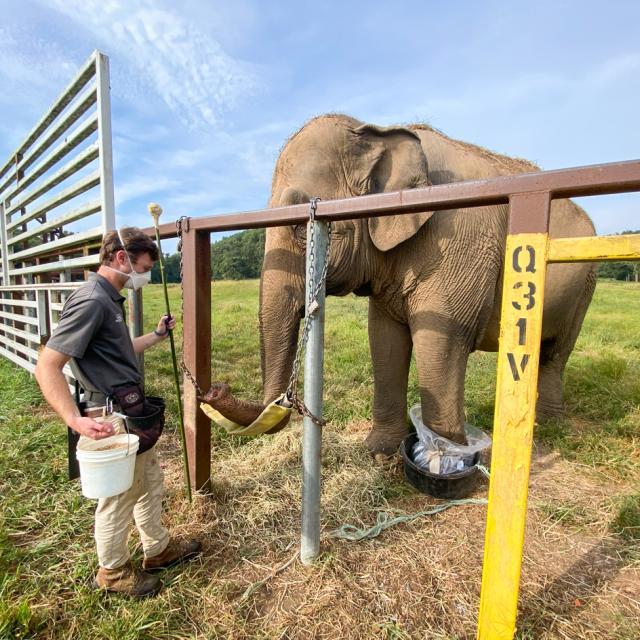
tuberculosis treatments — involving two caregivers, a team
of veterinarians and the use of a restraining chute in which harnesses
are secured about her chest and tail — without any coaxing
or pressure. “We’ll shower her with praise in the barn
afterwards,” Buckley told me as Misty stood by, chomping on
a mouthful of hay, “and she actually purrs with pleasure.
The whole barn vibrates.”
Of course, Misty’s road to recovery — when viewed in
light of her history and that of all the other captive elephants,
past and present — is as harrowing as it is heartening. She
and the others have suffered, we now understand, not simply because
of us, but because they are, by and large, us. If as recently as
the end of the Vietnam War people were still balking at the idea
that a soldier, for example, could be physically disabled by a psychological
harm — the idea, in other words, that the mind is not an entity
apart from the body and therefore just as woundable as any limb — we
now find ourselves having to make an equally profound and, for many,
even more difficult leap: that a fellow creature as ostensibly unlike
us in every way as an elephant is as precisely and intricately woundable
as we are. And while such knowledge naturally places an added burden
upon us, the keepers, that burden is now being greatly compounded
by the fact that sudden violent outbursts like Misty’s can
no longer be dismissed as the inevitable
isolated revolts of a restless few against the constraints and abuses
of captivity.
They have no future without us. The question
we are now forced to grapple with is whether we would mind a future
without them, among the more mindful creatures on this earth and,
in many ways, the most devoted. Indeed, the manner of the elephants’ continued
keeping, their restoration and conservation, both in civil confines
and what’s left of wild ones, is now drawing the attention
of everyone from naturalists to neuroscientists. Too much about
elephants, in the end — their desires and devotions, their
vulnerability and tremendous resilience — reminds us of ourselves
to dismiss out of hand this revolt they’re currently staging
against their own dismissal. And while our concern may ultimately
be rooted in that most human of impulses — the preservation
of our own self-image — the great paradox about this particular
moment in our history with elephants
is that saving them will require finally getting past ourselves;
it will demand the ultimate act of deep, interspecies empathy.
On a more immediate, practical level, as
Gay Bradshaw sees it, this involves taking what has been learned
about elephant society, psychology and emotion and inculcating
that knowledge into the conservation schemes of researchers and
park rangers. This includes doing things like expanding elephant
habitat to what it used to be historically and avoiding the use
of culling and translocations as conservation tools. “If we want elephants around,” Bradshaw told
me, “then what we need to do is simple: learn how to live
with elephants. In other words, in addition
to conservation, we need to educate people how to live with wild
animals like humans used to do, and to create conditions whereby
people can live on their land and live with elephants without it
being this life-and-death situation.”
The other part of our newly emerging compact
with elephants, however, is far more difficult to codify. It requires
nothing less than a fundamental shift in the way we look at animals
and, by extension, ourselves. It requires what Bradshaw somewhat
whimsically refers to as a new “trans-species psyche,” a commitment to
move beyond an anthropocentric frame of reference and, in effect,
be elephants. Two years ago, Bradshaw wrote a paper for the journal
Society and Animals, focusing on the work of the David Sheldrick
Wildlife Trust in Kenya, a sanctuary for orphaned and traumatized
wild elephants — more or less the wilderness-based complement
to Carol Buckley’s trauma therapy at the Elephant Sanctuary
in Tennessee. The trust’s human caregivers essentially serve
as surrogate mothers to young orphan elephants, gradually restoring
their psychological and emotional well being to the point at which
they can be reintroduced into existing wild herds. The human “allomothers” stay
by their adopted young orphans’ sides, even sleeping with
them at night in stables. The caregivers
make sure, however, to rotate from one elephant to the next so that
the orphans grow fond of all the keepers. Otherwise an elephant
would form such a strong bond with one keeper that whenever he or
she was absent, that elephant would grieve as if over the loss of
another family member, often becoming physically ill itself.
To date, the Sheldrick Trust has successfully
rehabilitated more than 60 elephants and reintroduced them
into wild herds. A number of them have
periodically returned to the sanctuary with their own wild-born
calves in order to reunite with their human allomothers and to
introduce their offspring to what — out on this uncharted
frontier of the new “trans-species psyche” — is
now being recognized, at least by the
elephants, it seems, as a whole new subspecies: the human allograndmother. “Traditionally,
nature has served as a source of healing
for humans,” Bradshaw
told me. “Now humans can participate actively in the healing
of both themselves and nonhuman animals.
The trust and the sanctuary are the beginnings
of a mutually benefiting interspecies culture.”
On my way back to New York via London, I
contacted Felicity de Zulueta, a psychiatrist at Maudsley Hospital
in London who treats victims of extreme trauma, among them former
child soldiers from the Lord’s Resistance Army. De Zulueta, an acquaintance of
Eve Abe’s, grew up in Uganda in the early 1960’s on
the outskirts of Queen Elizabeth National
Park, near where her father, a malaria doctor, had set up camp as
part of a malaria-eradication program. For a time she had her own
elephant, orphaned by poaching, that local villagers had given to
her father, who brought it home to the family garage, where it immediately
bonded with an orphan antelope and dog already residing there.
“He was doing fine,” de Zulueta told me of the pet
elephant. “My mother was loving it and feeding it, and then
my parents realized, How can we keep
this elephant that is going to grow bigger than the garage? So they
gave it to who they thought were the experts. They sent him to the
Entebbe Zoo, and although they gave him all the right food and everything,
he was a lonely little elephant, and he died. He had no attachment.”
For de Zulueta, the parallel that Abe draws
between the plight of war orphans, human and elephant, is painfully
apt, yet also provides some cause for hope, given the often startling
capacity of both animals for recovery. She told me that one Ugandan
war orphan she is currently treating lost all the members of his
family except for two older brothers. Remarkably, one of those
brothers, while serving in the Ugandan Army, rescued the younger
sibling from the Lord’s Resistance Army; the older brother’s
unit had captured the rebel battalion in which his younger brother
had been forced to fight.
The two brothers eventually made their way
to London, and for the past two years, the younger brother has
been going through a gradual process of recovery in the care of
Maudsley Hospital. Much of the rehabilitation, according to de
Zulueta, especially in the early stages, relies on the basic human
trauma therapy principles now being applied to elephants: providing
decent living quarters, establishing a sense of safety and of
attachment to a larger community and allowing freedom of choice.
After that have come the more complex treatments tailored to the
human brain’s particular cognitive capacities:
things like reliving the original traumatic
experience and being taught to modulate feelings through early
detection of hyperarousal and through breathing techniques. And
the healing of trauma, as de Zulueta describes it, turns out to
have physical correlatives in the brain just as its wounding does.
“What I say is, we find bypass,” she explained. “We
bypass the wounded areas using various techniques. Some of the wounds
are not healable. Their scars remain. But there is hope because
the brain is an enormous computer, and you can learn to bypass its
wounds by finding different methods of approaching life. Of course
there may be moments when something happens and the old wound becomes
unbearable. Still, people do recover. The boy I’ve been telling
you about is 18 now, and he has survived very well in terms of his
emotional health and capacities. He’s a lovely, lovely man.
And he’s a poet. He writes beautiful poetry.”
On the afternoon in July that I left the
Elephant Sanctuary in Tennessee, Carol Buckley and Scott Blais
seemed in particularly good spirits. Misty was only weeks away
from the end of her quarantine, and she would soon be able to
socialize with some of her old cohorts from the Hawthorn Corporation:
eight female Asians that had been given over to the sanctuary.
I would meet the lot of them that day, driving from one to the
next on the back of Buckley’s four-wheeler
across the sanctuary’s savanna-like stretches. Buckley and
Blais refer to them collectively as the
Divas.
Buckley and Blais told me that they got word
not long ago of a significant breakthrough in a campaign of theirs
to get elephants out of entertainment and zoos: the Bronx Zoo,
one of the oldest and most formidable zoos in the country, had
announced that upon the death of the zoo’s three current elephant inhabitants,
Patty, Maxine and Happy, it would phase out its elephant exhibit
on social-behavioral grounds — an acknowledgment of a new
awareness of the elephant’s very particular sensibility and
needs. “They’re really taking the lead,” Buckley
told me. “Zoos don’t want to concede the inappropriateness
of keeping elephants in such confines. But if we as a society determine
that an animal like this suffers in captivity, if the information
shows us that they do, hey, we are the stewards. You’d think
we’d want to do the right thing.”
Four days later, I received an e-mail message
from Gay Bradshaw, who consults with Buckley and Blais on their
various stress-therapy strategies. She wrote that one of the sanctuary’s elephants,
an Asian named Winkie, had just killed a 36-year-old female assistant
caretaker and critically injured the male caretaker who’d
tried to save her.
People who work with animals on a daily basis
can tell you all kinds of stories about their distinct personalities
and natures. I’d gotten, in fact, an elaborate breakdown from Buckley and
Blais on the various elephants at the sanctuary and their sociopolitical
maneuverings within the sanctuary’s distinct elephant culture,
and I went to my notebook to get a fix again on Winkie. A 40-year-old,
7,600-pound female from Burma, she came to the sanctuary in 2000
from the Henry Vilas Zoo in Madison, Wisc., where she had a reputation
for lashing out at keepers. When Winkie first arrived at the sanctuary,
Buckley told me, she used to jump merely upon being touched and
then would wait for a confrontation. But when it never came, she
slowly calmed down. “Has never lashed out at primary keepers,” my
last note on Winkie reads, “but has at secondary ones.”
Bradshaw’s e-mail message concludes: “A
stunning illustration of trauma in elephants. The indelible etching.”
I thought back to a moment in Queen Elizabeth
National Park this past June. As Nelson Okello and I sat waiting
for the matriarch and her calf to pass, he mentioned to me an
odd little detail about the killing two months earlier of the
man from the village of Katwe, something that, the more I thought
about it, seemed to capture this particularly fraught moment we’ve arrived at with the elephants.
Okello said that after the man’s killing, the elephant herd
buried him as it would one of its own,
carefully covering the body with earth and brush and then standing
vigil over it.
Even as we’re forcing them out, it seems, the elephants are
going out of their way to put us, the keepers, in an ever more discomfiting
place, challenging us to preserve someplace for them, the ones who
in many ways seem to regard the matter of life and death more devoutly
than we. In fact, elephant culture could be considered the precursor
of our own, the first permanent human settlements having sprung
up around the desire of wandering tribes to stay by the graves of
their dead. “The city of the dead,” as Lewis Mumford
once wrote, “antedates the city of the living.”
When a group of villagers from Katwe went
out to reclaim the man’s
body for his family’s funeral rites, the elephants refused
to budge. Human remains, a number of researchers have observed,
are the only other ones that elephants will treat as they do their
own. In the end, the villagers resorted to a tactic that has long
been etched in the elephant’s collective memory, firing volleys
of gunfire into the air at close range,
finally scaring the mourning herd away.