Biodiversity
/ Horizon Solutions Site
June 25, 2007
Original Article
Tarra
Sprays Herself
Tarra was imported from Burma
in 1974. She is short and stout with a very dark
complexion which is indicative of elephants from
her region. Her tail is quite long; the end is
covered with thick hair, quite effective for
swatting insects. Her small ears fold back at
the top.Height: 8' 2" Weight: 8700 lbs.Favorite
Food: Watermelon
The Elephant Sanctuary founded
in 1995 in Hohenwald, Tennessee, is the nation's
largest natural-habitat refuge developed specifically
to meet the needs of endangered elephants.
It is a non-profit organization, licensed by
the U.S. Department of Agriculture and the Tennessee
Wildlife Resources Agency. It is designed specifically
for old, sick or needy African and Asian elephants
who have been retired from zoos and circuses.
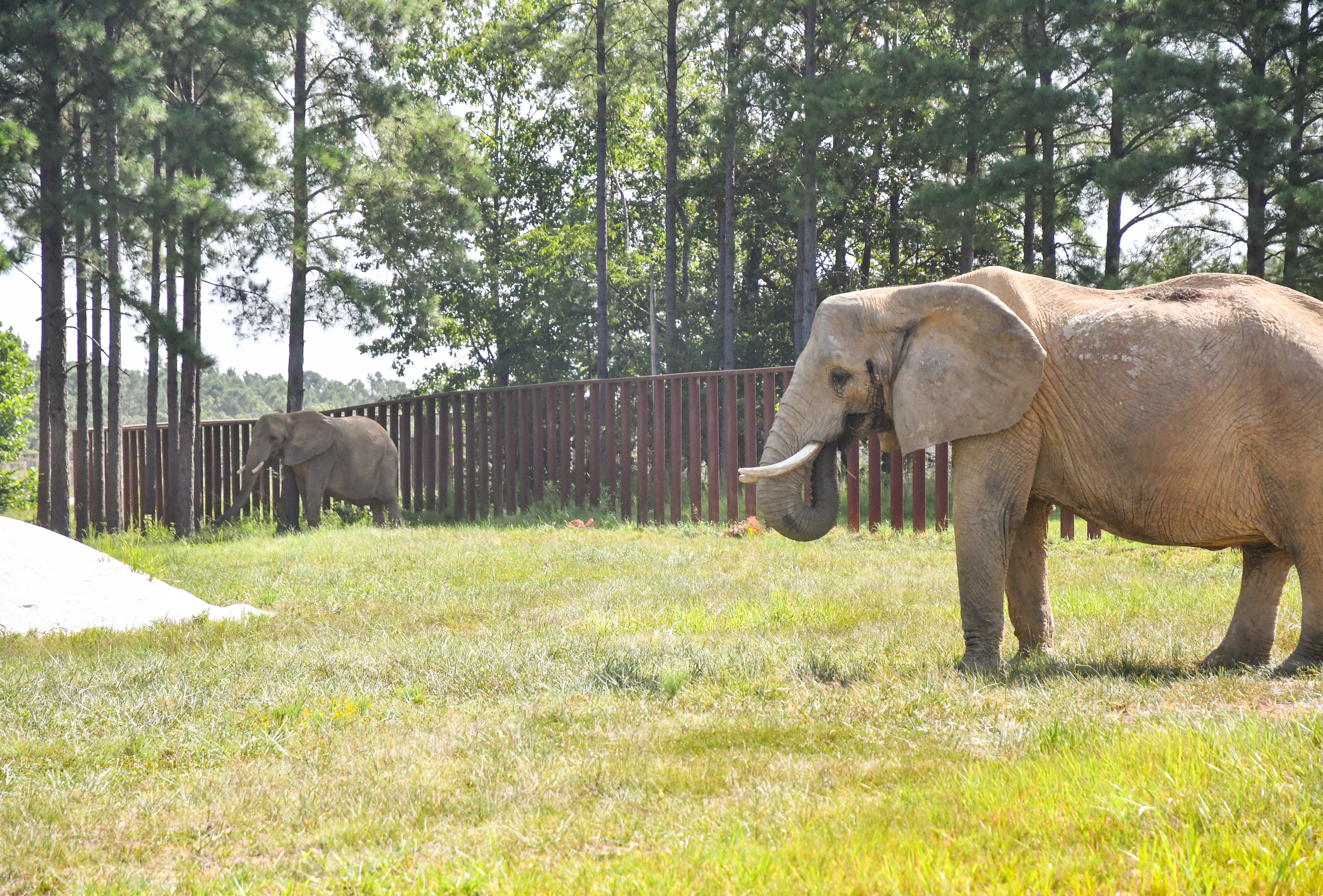
Sun filters through lush vegetation in the
Sanctuary woodlands.
Three separate and protected, natural-habitat
environments have been created for Asian and
African elephants. “Our residents are not
required to perform or entertain for the public;
instead, they are encouraged to live like elephants,” according
to the Sanctuary mission statement. The Sanctuary
provides a haven for elephants in a setting of
green pastures, old-growth forests, spring-fed
ponds and a heated barn for cold winter nights.
The Sanctuary’s mission is also to provide
education “about the crisis facing these
social, sensitive, passionately intense, playful,
complex, exceedingly intelligent and endangered
creatures.”
Phil Snyder, regional director emeritus of the
Humane Society of the United States has stated, "The
Elephant Sanctuary represents the future of enlightened
captive elephant management."
Carol Buckley, Executive Director
and co-founder of The Elephant Sanctuary, has
spent 30 years caring for and managing elephants
in captivity.
Tarra looking for blackberries.
When she was first year student in the Exotic
Animal Training and Management Program at Moorpark
College in California, she came across Tarra,
a one year old infant at the time, living in
back of a truck on exhibit at a local tire store.
Tarra, a female Asian elephant, won her heart.
Soon Carol became a volunteer, caring for Tarra
and, as she says, “grew overprotective.” Carol
said, “Tarra was anemic and miserable living
in the back of the truck. While I volunteered
I trained her to do basic circus tricks, running
around the traditional circus ring, playing musical
instruments, dancing, skip, and to wave “goodbye” with
her trunk. Tarra was so cooperative and intelligent
that I was able to teach her to roller skate.
She became the world’s only roller skating
elephant,” Carol said.
It took her a while, but after a year and a
half, she managed to purchase her.
“Unfortunately, while Tarra had fun, or seemed
to have fun roller skating, animal activists thought
I was doing something bad. They criticized me and
made me reconsider what we were doing.”
For nearly fifteen years Carol went on to travel
the US, Canada and abroad performing in a number
of circuses including Circus Gatini in Quebec,
Canada and the Big Apple Circus in New York City.
Carol owned and operated her own elephant management
company, Tarra Productions, for twenty years.
Her experience with Tarra Productions included
promoting, exhibiting, training and caring for
Tarra who performed for television, motion pictures
and circus shows.
Carol implemented educational demonstrations
for a number of zoos throughout North America
including Racine Zoo, Santa Barbara Zoo, Kansas
City Zoo, Nashville Zoo and Granby Zoo in Quebec,
Canada.
Motivated by the plight facing
captive elephants and inspired by Tarra, in 1995,
Carol co-founded the Elephant Sanctuary. It is
recognized as the nation's first natural-habitat
refuge for sick, old and needy endangered Asian
elephants. Carol was honored as “A Hero
for the Planet” by
TIME magazine for her innovative work.
Tarra cannot wait to meet Dulary
Photo by Nancy Rhoda
As Executive Director, she helps
to care for elephants at the Sanctuary, oversee
the administrative office, organizes elephant
acquisitions, develops and implements educational
programs for the public, and works with governmental
agencies and private organizations to strengthen
regulations pertaining to the welfare of captive
elephants. She is a well-known speaker on the
subject of elephant care.
Scott Blais, the Sanctuary’s co-founder, is Operations Director and the
primary caregiver for eight of the Sanctuary's elephants that live in the newly
expanded habitat of 2,200 acres known as New Asia. He and Carol design, develop
and direct the 2700 acre natural-habitat refuge.
Dulary. What a gem Dulary is! She has been steadily
acclimating to her new environment, new elephants
and new caregivers. She is independent but
spends time with the other elephants, especially
Misty, Delhi and Tarra. She is a strong-willed,
self-confident individual—all
traits that make her a prime candidate for life
at the Sanctuary. After only a month, she began
to interact in a respectful way with her caregivers
which is always cause for celebration. Weight:
8,508 pounds Favorite Food: Sugar Cane
Scott
has been managing and caring for Asian elephants
for over fifteen years. While studying biology
at York University in Ontario, Canada, Scott
spent five years as an elephant keeper at Ontario's
African Lion Safari. As an elephant keeper,
he treated sick animals, monitored elephant breeding,
trained elephants, assisted in the training
of other keepers, and presented educational demonstrations
and elephant rides to the public. In 1993,
Scott accepted employment with Tarra Productions
providing care for Tarra for two-years prior
to opening the Sanctuary.
Asian
Elephant Habitat as far as the eye can see
Scott has been instrumental in the design
and construction of the Sanctuary's new state
of the art elephant house and administrative
office, as well as the 20 miles of Sanctuary
fencing. He also aids in implementing public
education programs about the plight of captive
elephants.
At the Sanctuary, Tarra, is “independent,
precocious, and very much the baby of the family.
Other elephants look after her and treat her
like a kid and she loves it,” Carol said.
When asked how she managed to start The Elephant
Sanctuary, Carol said that “there were
difficulties, of course. After substantial
searching the right location, we had a couple
false starts in Costa Rica . We considered
partnering with a zoo that shared our philosophy
and mission, but that situation involved having
only 35 acres.”
“We realized we needed to set out on our
own. After a year and a half, we found land in
Tennessee.” The first parcel was 112 acres,
not substantial; however, it had abutting land
we could hope to acquire later.”
“Then, of course, there was the need for
financing. We went to a bank for a loan. The
bank president was intrigued with idea. Success.
We were on our way with our first 112 acres.”
The Sanctuary now has 2700 acres with a double
fencing system 7 feet tall. It is home to 19
elephants. There are three separate habitats
complete with elephant houses and hundreds
of acres each. One is for Africans, one is
for Asians and the third is designated as a
quarantine facility.
Flora. Flora was orphaned at two years old when her
family was killed in a culling in Zimbabwe
Africa. Her entire captive life has been spent
traveling and performing with her namesake,
Circus Flora. She is the youngest member of
our African herd, only 22 years old. Flora
is a beautiful elephant weighing 10,000 - pure
muscle. She has a healthy set of ivory which
is a little shorter than Zula's but longer
than Tange's. When interacting with Zula she
is usually the elephant whose trunk, head and
ivory are held the highest. Height: 8' 9",Weight:
10,020 lbs..Favorite Food: Bananas
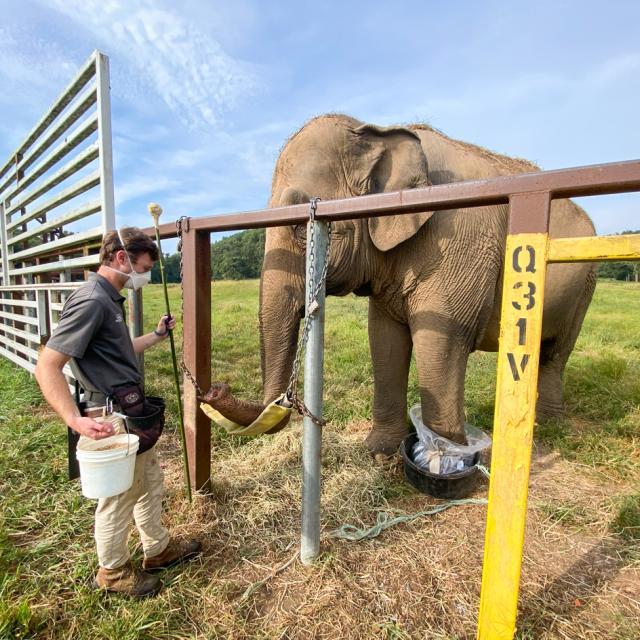
The elephants forage for their own food year-round. During the growing season
80 % of their diet is derived from the habitat. The remaining 20% is provided
by caregivers who deliver the elephant groceries on 4-wheelers. The elephants
enjoy access to a vast habitat, with abundance and diverse vegetation, where
they can roam the 30 miles a day that is normal for elephants in the wild.
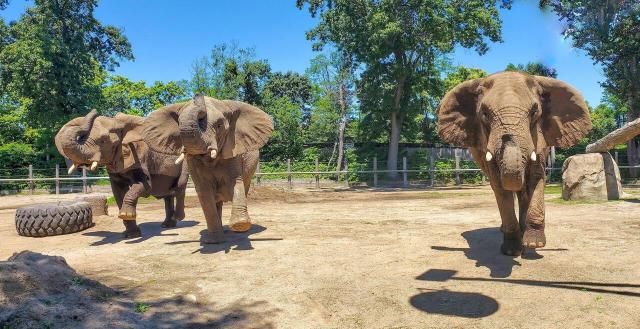
All the elephants are females. Females are very sociable while all males tend
to be solitary in the wild.
The Sanctuary has grown thanks to “word of mouth and reputation,” according
to Carol. It now has 67,000 members who each contribute whatever they can and
many are very active some contribute several times a year.”
“Because of the results of our work, we feel strongly that we can provide
a secure life for these elephants, for their entire lifetime.”
“We have recently started a program for elephant care focusing on building
our staff,” she added.
The 22 member staff includes a year round internship program with paid and
non-paid internships. There are small cabins for interns, many of whom serve
during the summer for a minimum of six weeks.
“This work is profoundly rewarding, not only from the satisfaction of giving
a haven to elephants who are in need of sanctuary, but in setting an example
for all captive animals. When you contribute to work like ours you are benefiting
the whole animal kingdom.”
The Elephant Sanctuary Web site offers daily news, video clips, short video
and photographic stories about each of its elephants, and other resources including
a comprehensive history of the Sanctuary Goals, those achieved, currently sought,
and their future expectation.
Barbara. Read about Barbara on the Elephhant Sanctuary Web site.
Photos courtesy of The Elephant Sanctuary in Tennessee
Read each elephant's biography at http://www.elephants.com/bios.htm
and their diaries at http://www.elephants.com/elediary.htm
Contact:
Kate Elliott-Managing Director
The Elephant Sanctuary in Tennessee
PO Box 393
Hohenwald TN 38462
kate@elephants.com
www.elephants.com
|