By Jeanette Steele
Union-Tribune Staff Writer
June 19, 2005
They are a natural spectacle: elephants,
with their flapping ears and loose skin
like baggy trousers. Many people grew
up watching these graceful giants at
zoos.
But
recent controversies in several
cities across the country – including
the deaths of three elephants that
once lived at the San Diego Zoo – spotlight
an issue that animal rights advocates
are rallying around: Is it humane
to keep the largest land mammal
on an acre or less, as many zoos
do?
That question is fast becoming
the center of a growing national
debate.
Zoo officials counter that their
methods are sound, and that they
are expanding the size of elephant
exhibits nationwide and increasing
their support for international
conservation programs for pachyderms
in the wild.
|

SEAN
M. HAFFEY / Union-Tribune
A 2,300-acre sanctuary tucked away in San Andreas is home to Wanda, a 47-year-old
Asian elephant from the Detroit Zoo.
|
However, seven U.S. zoos have given up their elephants in as many
years. Most notable are the San Francisco Zoo, which closed its
exhibit in March and sent its last elephant to a private sanctuary,
and the Detroit Zoo, where director Ron Kagan has become an unlikely
spokesman for the animal rights position on this issue. In a recent
speech, he said zoos are facing an identity crisis and could do
better by animals.
"The human desire to collect creatures and be amused by them
has not served animals well," Kagan said, accepting an award
from the Humane Society of the United States. "Zoo professionals
are now struggling to find an ethical foundation. Are we animal
advocates or just entertainers?"
The Zoological Society of San Diego, which operates the San Diego
Zoo and the Wild Animal Park near Escondido, stands center stage
in the elephant debate.
The society infuriated animal rights groups when it imported seven
wild African elephants from Swaziland in 2003. Zoo officials said
they were rescuing the young elephants, which were scheduled to
be killed because of overpopulation at an animal park there.
To make
room for the newcomers, the zoo
sent three older elephants – Peaches,
Tatima and Wankie – to Chicago's
Lincoln Park Zoo.
Tatima died in
October from a long-standing
infection, said zoo officials,
and Peaches died in January of
old age. Wankie collapsed after
being transferred to a Utah zoo
from Chicago and was euthanized
in May.
Zoo officials don't regret the
move to Chicago, saying there's
no evidence that it hurt the elephants.
Animal rights advocates have protested,
saying the move and the cold weather
worsened their conditions. |

SEAN M. HAFFEY / Union-Tribune
Officials at the San Diego Zoo in Balboa Park say they hope to revamp the elephant
enclosure, built in 1963, but have no set timetable.
|
The next debates may be in El Paso, Texas, and Los Angeles.
El Paso's City Council is scheduled to vote in July on whether
to send two elephants to a Tennessee sanctuary. One El Paso pachyderm
was shipped to Tennessee in 2000 after a video surfaced showing
a trainer beating the animal.
Closer to home, Los Angeles Mayor-elect Antonio Villaraigosa said
during his campaign that the Los Angeles Zoo, with its three elephants,
needs to become more humane. In a recent TV interview he said, "We
need to move the elephants out."
Elected officials also got involved in San Francisco and Chicago,
making it clear that the debate is no longer just between animal
rights advocates and zoos.
Habitat size debate
Animal rights groups advocate sending the 300 elephants at mainstream
North American zoos to sanctuaries and bringing no more in from
the wild.
Their main issue is habitat size.
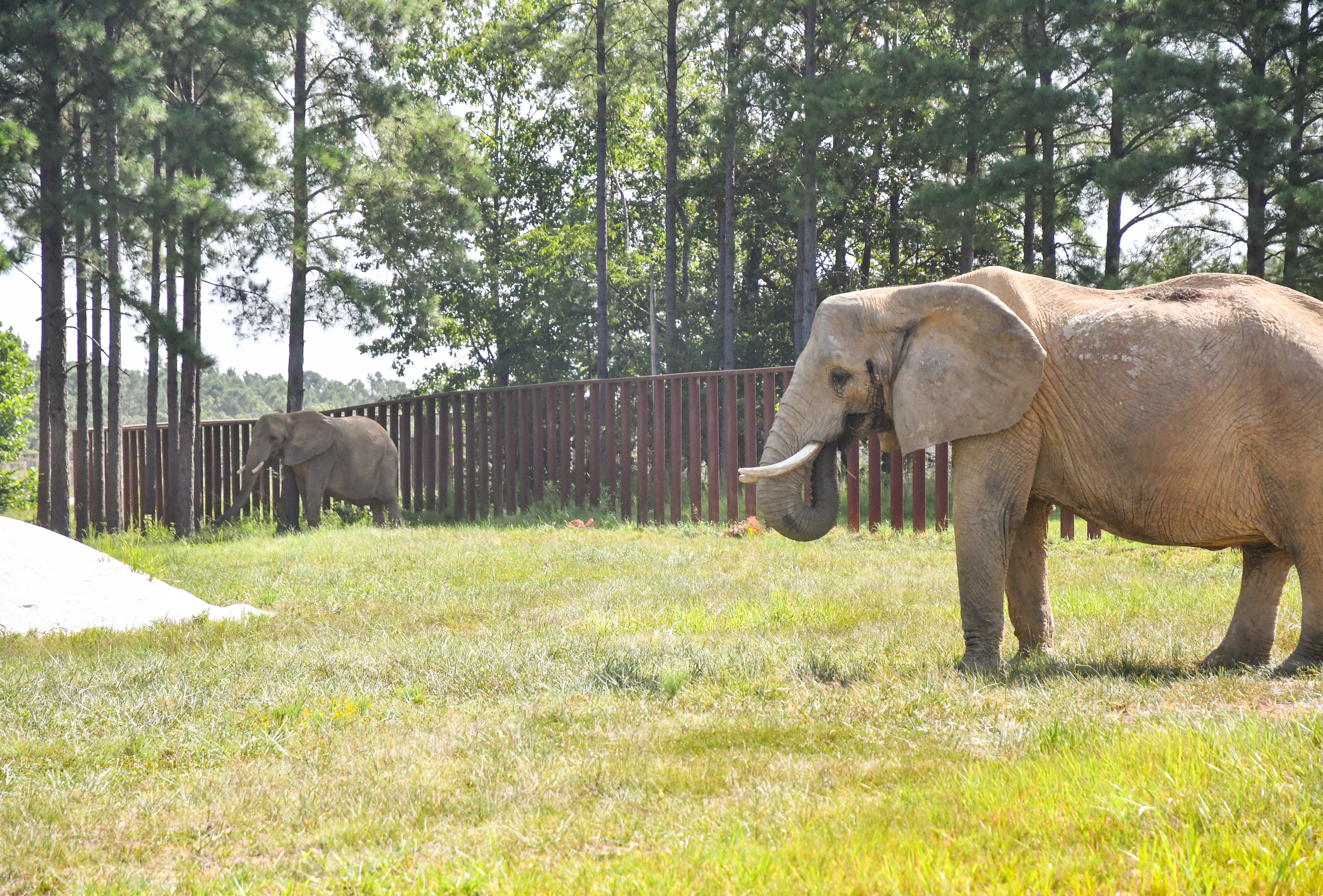
The largest U.S. zoo habitat for elephants is believed to be the
more than 8 acres at Disney's Animal Kingdom in Florida.
The San Diego Wild Animal Park has its African herd on 2 and 1/2
acres, and its Asian elephants live on an acre.
At the San Diego Zoo in Balboa Park,
three elephants share a 17,000-square-foot
enclosure built in 1963.
That's not enough space for animals that roam 20 to 50 miles a
day in the wild, animal rights groups say.
Restricted quarters
lead to foot disease and arthritis,
common problems with captive elephants,
they say. And they argue that decayed
foot pads and joint problems result
from standing on concrete floors
in zoo barns.
Activists say the boredom of confinement
leads to neurotic behavior among
elephants. Swaying back and forth
is one sign, they assert.
Also, zoo elephants die young,
animal rights activists say. In
the wild, they can live to 70.
A study by People for the Ethical
Treatment of Animals and In Defense
of Animals found that more than
half of the 39 elephants that have
died at mainstream zoos since 2000
never reached their 40th birthday.
"Zoos cannot adequately provide
for elephants," said Nicole
Meyer, a PETA spokeswoman.
A few scientists have spoken out
in support of animal activist concerns.
|

SEAN M. HAFFEY / Union-Tribune
Annie, an Asian elephant, got a pachyderm pedicure from former Hollywood animal
trainer Pat Derby at the elephant sanctuary she established in 1985.
|
"Zoos should not be lending elephants here and there, separating
mothers from calves, splitting families and friends. To keep a group
together means space," said Joyce Poole, an animal behaviorist
who studied elephants for 30 years in Africa. "They need space
outside. They need space to be elephants."
Zoo officials disagree.
Space isn't everything, said officials from the San Diego Zoo and
the American Zoo and Aquarium Association, which represents the
zoo industry.
"The fact that someone said an elephant has to move 20 miles
a day, that to me is putting an unrealistic number on the situation," said
Larry Killmar, the San Diego Zoo's associate director of collections.
Since zoo elephants are provided their food, water and breeding
partners, there's no reason for them to roam miles, as they must
in the wild, Killmar said.
"It's not part of their survival, and that's where the fact
and the fiction get mixed up," he said.
Mike Keele, chairman of the zoo industry's committee on elephant
species survival, said zoo professionals haven't seen any research
that shows elephants need to walk miles to maintain their feet.
"There's zero science to support what kind of space is needed
at this point in time," said Keele, deputy director of the
Oregon Zoo in Portland.
Industry standards demand a minimum of 2,200 square feet for a
single elephant – about the size of a four-bedroom house in
the suburbs. An extra 1,300 square feet is required for each additional
elephant.
Zoo officials acknowledge that elephants are herd animals. They
say they try to keep them together.
The industry's rule book also says zoos should have at least three
female elephants to keep one another company. Males can live alone,
but not in total isolation.
As for dying young, zoo officials said that's a misapplication
of the statistics.
"It's true that elephants can live to 70. But people can live
to, say, 120," Keele said. "Most of us don't, and it's
the same with elephants. Most of them don't."
For love of Dunda
Scrutiny of zoo elephant treatment isn't new; it has been building
for several years.
Florence Lambert was never an animal rights activist – until
Dunda.
In 1988, the retired La Jolla nurse saw televised images of the
bloodied African elephant at the Wild Animal Park. Zoo keepers acknowledged
they hit Dunda with ax handles to stop aggressive behavior.
"It just bothered me, and all night long I couldn't sleep," Lambert
said. "It just haunted me, the head of that dear elephant.
It will always be in my mind, I think."
She worked with state legislators to pass a 1989 law barring beatings
severe enough to leave scars. And in 1991, Lambert founded the nonprofit
Elephant Alliance, which works to end what she calls abuse of elephants
by zoos and circuses. Her group has 800 members nationwide.
In Defense of Animals,
a Northern California-based group,
got interested in the elephant
issue five years ago over the fate
of the San Francisco Zoo's four
aging elephants. Many people credit
the group's campaign with influencing
city officials to pressure the
zoo to move the two surviving elephants
to a Northern California sanctuary.
Virginia-based People for the
Ethical Treatment of Animals ramped
up its efforts on behalf of elephants
in 1992 after a circus elephant
in Florida rampaged and was killed.
Over the past 20 years, the zoo
industry has changed its own approach
to handling elephants.
|

SEAN M. HAFFEY / Union-Tribune
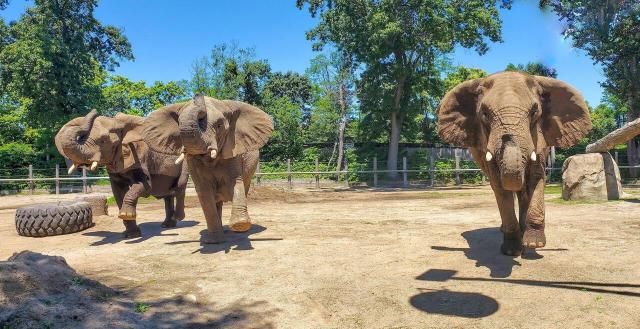
The three Asian and African elephants at the San Diego Zoo in Balboa Park share
a 17,000-square-foot enclosure that is considered large by zoo standards. Animal
rights groups say this still isn't enough space for animals that roam 20 to 50
miles a day in the wild.
|
At one time, all keepers worked face to face with
elephants and established dominance by using a bullhook, a long
stick with a metal hook on the tip. The industry now restricts how
the bullhook can be used.
Since the early 1990s, some zoos have embraced a
new system that keeps elephants and humans separated and relies
on positive reinforcement.
At the San Diego Zoo, for example, keepers never
enter the elephant yard. Instead, they use treats to coax the animals
to do what they say from behind a wall of bars.
Zoos also pay closer attention to elephants' feet.
After a 1998 conference, the industry published a book that recommended
natural surfaces, such as dirt or grass, for elephants to walk on.
"That was a point in time where we all kind of woke up and
said, 'There's a lot of things we could do about how we manage our
(elephants') foot health and what we do in our exhibits,' " said
Keele, the Oregon zoo's deputy director. "I think that's made
a difference."
Those changes were inspired by practices at European zoos, Keele
said. The animal rights lobby also played a part in the changes,
he acknowledged, though he now questions the motives for the current
push with elephants.
"There was a time when I think that kind of pressure from
animal rights and animal welfare groups made us look at our situation
very seriously," Keele said. "Some of those criticisms
were helpful. We've gone beyond that now.
"I think there's a very different agenda today. I don't think
it's about animal care at all. I think it's about closing zoos."
Homes on the range
The idea of an elephant sanctuary dates back at least to 1985.
That's when Pat Derby, a former Hollywood animal trainer, established
a small haven for retired circus and other show animals. She now
cares for eight elephants on part of her 2,300-acre sanctuary in
the rolling hills of Calaveras County.
In 1995, former elephant trainer Carol Buckley founded an all-elephant
sanctuary in Tennessee that now sprawls over 2,700 acres.
Derby's place is the new home of Wanda and Winky from the Detroit
Zoo and Lulu, a former San Francisco Zoo resident.
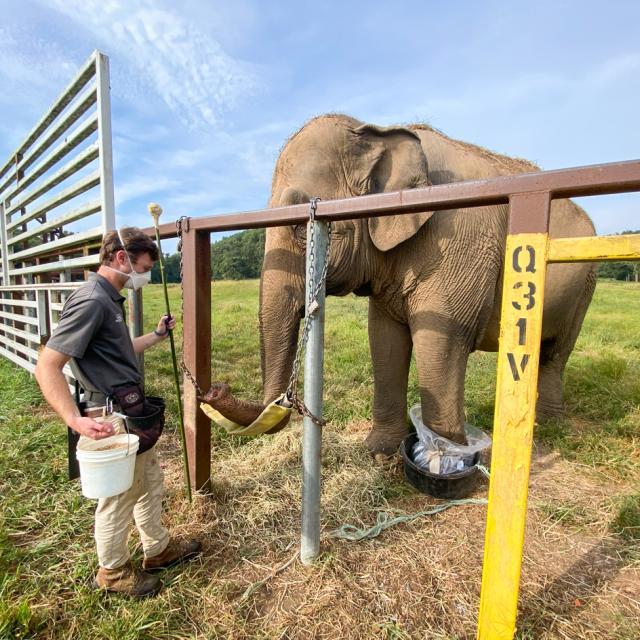
Derby talks to them and the others in a chirpy, singsong voice
as she does her daily chores: spraying the pachyderms with a hose
for morning baths, soaking sore feet in Epsom-salt washes and handing
them green bell peppers, carrots and loaves of sandwich bread as
treats.
Eight full-time keepers watch the elephants around the clock.
The animals wander into one of the sanctuary's two 20,000-square-foot
barns on their own for meals and baths. Most of the day is spent
grazing the grassy meadows outside.
The three African elephants have 75 acres for roaming, and the
five smaller Asian elephants have 40 acres.
Derby was thrilled to see Wanda using her trunk to pull leaves
off a tree. Detroit zookeepers told her the 47-year-old elephant's
trunk was partially paralyzed, but Wanda was giving the tree a good
fight for its leaves.
Derby and Buckley both say they see vast improvements in the elephants'
health since arrival.
"Every elephant that comes to the sanctuary has foot problems.
Every single one, in varying degrees," said Buckley, whose
facility has been home to 14 elephants over the past decade. All
but one have recovered, she said.
Many animal welfare advocates want to see all zoo elephants moved
to such a sanctuary, but Derby has a different view. The longtime
activist thinks animal groups ought to keep pressure on zoos to
improve their elephant programs.
"I look at nirvana as a time when people leave animals in
the wild totally and there's no captivity at all," she said. "But
for now there is, and there are zoos."
Derby is critical of the zoo industry for its breeding practices,
importation of wild elephants and use of bullhooks. But, she said, "that
doesn't mean 'zoo bad and sanctuary good.' "
Buckley thinks zoos could adopt the sanctuary concept themselves
by buying several hundred acres and letting elephants move freely
on them. Until that happens, she said, she is willing to take as
many pachyderms as zoos will retire to her.
Derby and Buckley run the two major elephant sanctuaries accredited
by the Association of Sanctuaries, a nonprofit group founded in
1992.
However, neither sanctuary is approved by the American Zoo and
Aquarium Association, the trade group that endorses 200 mainstream
zoos and aquariums.
That's one of the concerns zoo professionals have about them.
"I think that while (sanctuaries) can serve a purpose, what
would be appropriate is if they would come in line with the industry
and go through the accreditation process, like we do," said
Killmar of the San Diego Zoo.
Zoo industry officials said they worry about security at sanctuaries,
after a Siberian tiger escaped from a makeshift Ventura County sanctuary
in February and a man was attacked in March by chimpanzees that
broke out of their cage at a sanctuary near Bakersfield. Neither
place was accredited by the Association of Sanctuaries.
They also wonder what will happen to the elephants after the founders
of the sanctuaries die or retire.
"I'm just not comfortable that there's some sort of oversight
that looks at the long-term health of any of those organizations," Keele
said. "I worry about any kind of succession plan. Most of the
people at sanctuaries, they are kind of iconoclastic leaders. What
happens when those people leave?"
Derby and Buckley rebut the criticism by saying the standards at
their sanctuaries are better than those at zoos.
The Association of Sanctuaries calls for a minimum of 2 acres per
elephant, says elephants should never be housed alone and frowns
on herds smaller than five animals. It also does not allow any form
of punishment. Breeding is unacceptable.
Besides permitting smaller spaces for elephants, the American Zoo
and Aquarium Association doesn't forbid exhibits with single elephants
but suggests that females be kept in groups of three. It also encourages
captive breeding programs.
The sanctuary operators also say that as incorporated nonprofit
groups, they have boards of directors that will carry on the organization's
mission. Both sanctuaries have budgets of about $2 million annually,
largely through private and corporate donations.
The zoo industry has announced aggressive efforts over the past
six months for the betterment of elephants.
In January, the zoo trade association said its members will increase
support for conservation programs to help wild elephants in Africa
and Asia.
Additionally, 40 North American zoos plan to build new or expanded
elephant exhibits by 2010, the trade association said. That's more
than half of the 78 zoos that house elephants.
The industry released a poll last month that showed 95 percent
of adults who see elephants and rhinos at the zoo say they appreciate
the animals more.
Animal rights activists believe the industry's recent efforts show
that it is scrambling after months of bad elephant publicity.
"It's a smoke screen. I think the zoo industry is getting
very scared because the public is getting the facts," said
Deniz Bolbol, a Bay Area-based activist who lobbied to move the
San Francisco elephants.
The zoo industry seems to have a different view on where the debate
is headed.
Douglas Myers, director of the Zoological Society of San Diego,
is not worried. His group has 240,000 members, down from 2000 but
up overall since 1995.
"We have the largest membership of any nonprofit organization
like ours," Myers said. "Attendance is strong at both
the zoo and the park. People have great interest in the zoo."
_____________________________________________________
Jeanette Steele: (619) 293-1030; jen.steele@uniontrib.com