South Florida Sun-Sentinel
October 2, 2006
By
Ivette M. Yee
Original Article
Loxahatchee · Stumpy and Mamma are packing
their trunks.
After 25 years at Lion Country Safari, the peaceful pachyderms
are moving to other elephant-friendly places in the United States.
They've been the only African elephants for the public to see in
Broward, Palm Beach and Martin counties, but now they're leaving.
Lion Country Safari is participating in an elephant conservation
program by the Association of Zoos
and Aquariums, an accrediting organization for zoos. The program
calls for stringent elephant care guidelines and research to provide
better care for the animals. Officials with the program asked smaller
zoos and wildlife parks to donate their elephants to larger facilities
better equipped to take care of them.
Most of the 600 to 700 elephants in American zoos and circuses
don't have the opportunity to breed, according to the AZA. And too
many female elephants are left to live solitary lives, instead of
running in herds as they do in the wild.
AZA elephant experts say elephant habitats in zoos and parks need
to be a minimum of 10 acres. Lion Country Safari's "Elephant
Island," an expanse of grass with a cool moat and plenty of
hay, is about half that size, officials there said.
Until this summer, the island, located on a mock African plain,
was also home to Bulwagi and Ladybird. Bulwagi is now at Disney's
Animal Kingdom in Orlando, and Ladybird is at the Greenville Zoo
in South Carolina.
Animal Kingdom and the Miami Metrozoo are the closest parks with
elephants.
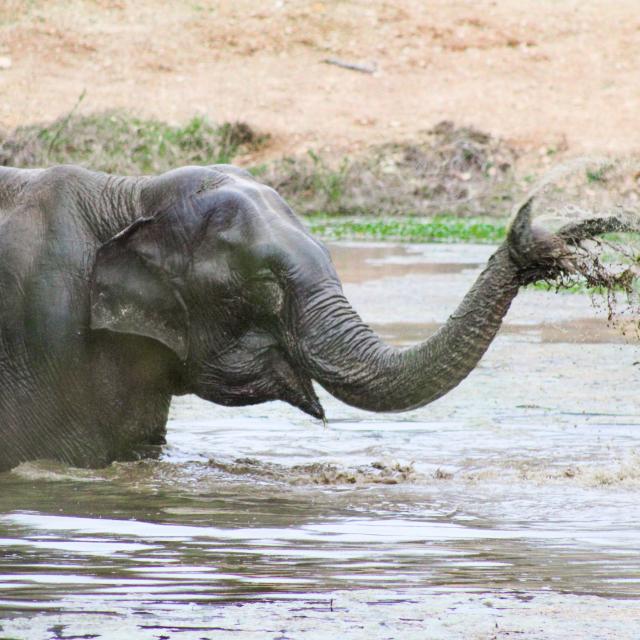
Now only Stumpy and Mamma roam the island together, scooping hay
and swatting at flies with their trunks. In a year, they will be
gone too, since that's how long the search for a suitable home will
take.
"This was a very hard decision for us, but it was the right
decision," said Terry Wolfe, wildlife director at Lion Country
Safari. "We are concerned about how this will affect visitorship,
but our visitors have to understand that we want what's best for
the elephants."
Lion Country Safari opened in 1964 as the first drive-through
safari park in the country. It introduced a new concept to animal
lovers, "the cageless zoo," and the elephants always have
been a beloved spectacle.
Drivers seem to linger when they reach Stumpy and Mamma, especially
during snack time. Each day about noon, the elephants dive for bagels
and show, unintentionally, the amazing things they can do with their
flexible trunks.
Elephant keepers hurl about 100 bagels into the moat. Without
fail, Stumpy, the matriarch, makes her way into the water when she
sees the trash bag full of bagels. Mamma waits for Stumpy to have
the first round. With their trunks, they easily catch, grab and
spoon the bread into their mouths.
Wolfe and his team of four elephant keepers have tended to Stumpy
and Mamma since they were toddlers. That includes baths twice a
week, pedicures every day and feeding.
"We're like the odd members of the herd," Wolfe said. "We
work with them every day, and they know who we are."
Caring for the elephants costs about $50,000 each per year, not
including salaries for the staff that takes care of them, Wolfe
said. But he doesn't cite that as a reason for moving them.
It's all about conservation, he said.
The AZA's goal with the elephant initiative is education and to
ensure a stable captive population. They hope it ends the capture
of wild elephants for display.
More than 143 million people visit North American zoos and aquariums
every year, according to the AZA. A Harris Interactive poll revealed
that an overwhelming majority of the public, about 95 percent, agreed
that seeing elephants in real life helps people appreciate them
more and encourages people to donate money to or spend time on animal
conservation efforts.
"Elephants are so popular, and a lot of zoos don't have them," said
Lee Sims, wildlife director at the Greenville Zoo. "You can
watch a video on Animal Planet, but it's not the same. You don't
really understand them until you look at them and see what they
can do."
Before Ladybird was moved to the Greenville Zoo to be a companion
to that zoo's 36-year-old elephant, Sims and keepers from each facility
visited the other for weeks. They spent time with both elephants.
Elephants are social creatures by nature. But, like humans, they
don't automatically get along.
"My fingers are raw from knocking on wood because it has
gone so well," Sims said. "The first couple of days it
was slow, but by the third day they were like, `OK, we want to be
near each other.'"
While a few parks and zoos are participating in the AZA's elephant
conservation program by donating their elephants, including the
Dallas Zoo and the Albuquerque Zoo, some zoos are upgrading to meet
AZA standards.
A 2005 AZA survey found that 40 of its 210-member facilities are
planning to expand or build elephant exhibits in the next five years.
"It is appropriate that zoos are now responding to the science
that shows elephants in captivity need a number of things: They
need space and a compatible group of other elephants," said
Carol Buckley, an Asian elephant expert and executive director of
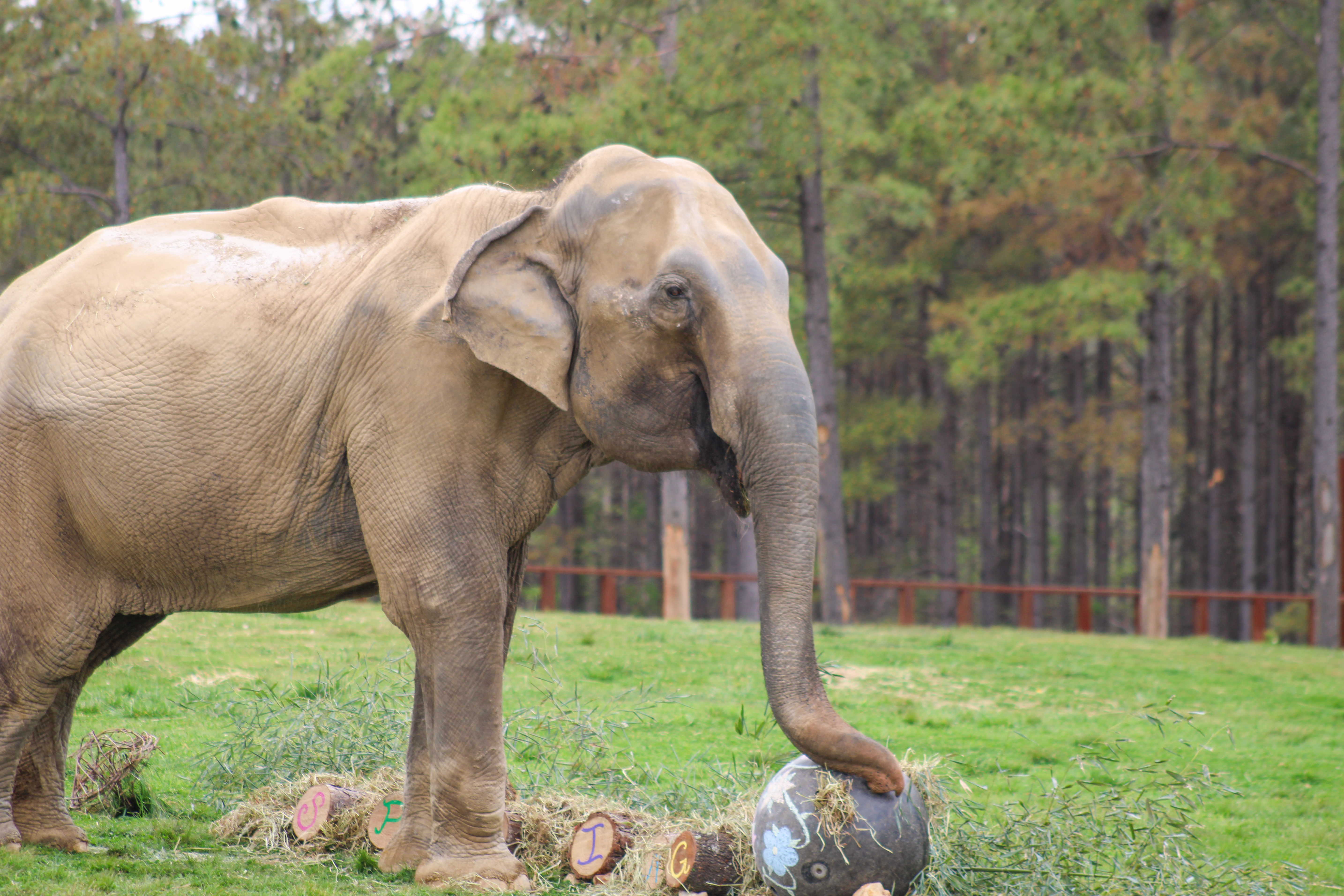
The Elephant Sanctuary, a 2,700-acre park for retired circus and
elderly elephants in Tennessee. "Since the beginning of zoos
in America, elephants have been kept in small spaces that cause
them to get ill or die at an early age."
With Stumpy, 48, and Mamma, 36, Wolfe and his staff are looking
to keep the two together and send them to join a herd.
"It used to be zoos had every type of animal, but we've learned
we can't have the sheer numbers or the cage after cage," said
Colleen Kinzley, general curator of the Oakland Zoo.
"I think people will learn to accept that once they learn
how these animals are supposed to be living and how they live in
the wild."