By William Mullen
Tribune staff reporter
May 29, 2005
HOHENWALD, Tenn. -- In the rural hills of central Tennessee,
workmen are almost finished installing electrified double fences
around 2,700 acres of forest: an 8-foot-high, chain-link barrier
on the outside, and a much stronger inner fence of tubular steel
and cable.
The strong one keeps huge animals inside. The other keeps the
public out.
This is the Elephant Sanctuary, a 10-year-old hospice for elderly,
ailing elephants from circuses and zoos. Here the animals spend
their final years roaming, dining on wild plants and cavorting
with their own kind.
Chicagoans began hearing a lot about it in October, when an
elephant died of a rare infection in Lincoln Park Zoo and animal-rights
activists demanded the zoo's other two elephants be sent to Hohenwald.
The subsequent deaths of those elephants--one from old age, one
apparently from the same infection--ratcheted up the fury over
not moving them.
It is an ongoing fight that illuminates the tensions between
the sanctuary and zoos and circuses that once voluntarily sent
ailing elephants to the unusual Tennessee facility. Now, with
the sanctuary often siding with animal-rights groups in their
fierce criticism of zoos, many resist sending animals there.
Still, some heartwarming success stories at the sanctuary have
made an impression on the North American zoo community, which
is considering building spacious elephant "conservation centers." Those
centers physically would resemble the Hohenwald sanctuary, but
the philosophical differences would be vast.
Sanctuary founder Carol Buckley will not allow her elephants
to breed; she only takes females. By definition, she says, a sanctuary
is a non-breeding facility where animals live out their lives.
She also won't let the public in to see the elephants, saying
they are not there to entertain visitors.
The very existence of zoos has always revolved around giving
people an up-close look at animals. Those visceral encounters,
the theory goes, generate appreciation for the peril animals face
in shrinking wildernesses globally. Zoos also maintain their captive
populations through breeding and manage them for genetic diversity,
a skill now needed to maintain wild populations.
Buckley, 51, and sanctuary co-founder Scott Blais, 32, have
long been outspoken in their feelings that nearly all zoos give
elephants inadequate, poorly designed spaces to live in, contributing
to chronic health problems.
They are adamant that elephants shouldn't be made to perform,
or even be kept on public display. They say no more should be
brought in from the wild and prefer that none be bred in captivity.
PETA praised
Buckley is forthright in her admiration and gratitude for People
for the Ethical Treatment of Animals, an animal-rights group that
wants to eliminate elephants from zoos. Some of the elephants
at the sanctuary arrived as a result of campaigns by PETA activists.
That is a big change of heart, she concedes, from the days when
she hired out to circuses, performing with a female Asian elephant
named Tarra that she had taught to roller skate.
In 1984, she said, a woman grabbed her after a show in California
and shouted: "That's abuse. You're abusing your animal by
making it skate like that."
The accusation stunned her. "I knew it wasn't abusive,
but the perception of it was that it was abusive," she said. "It
got me to look at the bigger picture of what and how we are going
to teach the public about these animals. Eventually I stopped
the act, because I realized it was sending the wrong message."
Over the next few years she began toying with the sanctuary
idea, especially after she and Tarra joined the African Lion Safari
in Ontario, where resident elephants could roam off-view from
the public, responsible only for performing regularly in an arena.
There she met Blais, then a teenager working as a part-time
keeper and being trained, she said, by men who controlled the
elephants with hooks and clubs. Blais was in awe when he saw Buckley
work with elephants.
"The guys would have a terrible struggle to get Rascha
[an elephant] to lay down for a bath. Carol showed me how to pat
her on the hind end and say, `OK, Rascha, you're a good girl,
and I'm going to ask you to lay down for a bath.' And she would,
with no fuss."
Buckley moved on, but she and Blais kept in touch, talking about
a sanctuary plan. In 1995 they found 110 suitable acres 85 miles
southwest of Nashville near Hohenwald, an old hill town hit hard
by its employers fleeing to cheap overseas labor. Bringing Tarra
along, they put up a barn for four elephants.
For a year, no money or other elephants came their way. Then
early in 1996, a circus owner asked Buckley to come to Florida
and take a sick elephant named Barbara. CNN also called, asking
if they could do a story on the move.
"The next thing you know," said Buckley, "we
got a $10,000 check from somebody who saw the show and liked the
idea of what we were doing. That really started things going."
Problems in captivity
More journalists did stories on the sanctuary, telling how Buckley
started it on the premise that elephants need access to large
amounts of space. In the wild they walk 30 to 50 miles daily,
she said, and denying captive elephants the ability to roam causes
them physical and psychic problems.
Many captive elephants die of bone disease, which she charges
comes from spending much of their lives standing on concrete surfaces.
Moreover, she contends that disease is prone to spread among animals
kept in close quarters.
The zoo community disagrees, noting that life expectancies for
wild and captive elephants are about the same and that wild elephants
are prone to the same foot injuries and diseases as captive ones.
But as a procession of ailing, older elephants arrived at the
sanctuary and seemed to thrive, Buckley found a powerful megaphone
in the media.
On July 6, 1999, National Geographic was at the sanctuary to
film the arrival of Shirley, a 52-year-old Asian elephant that
had been living alone in a Monroe, La., zoo for 22 years.
The TV crew had left for the day when Jenny, a 30-year-old gimpy
with arthritis, wandered into the barn from a day outdoors. Seeing
Shirley in a barn stall, Jenny began wailing with such passion
that Blais grabbed his own video recorder.
"Jenny knew right away who Shirley was and was wailing
and screaming," Buckley said. "Shirley wasn't quite
sure how to take the attention; then all of a sudden we saw her
eyes got big, like there was a jolt of recognition as she remembered
who Jenny was."
Buckley knew that in 1976, the two elephants had briefly been
owned by the same circus. It turned out Shirley, an adult, had
been housed with younger elephants while recovering from a broken
leg. Jenny, then 7, was in that group and immediately solicited
mothering from Shirley. They were together only a few weeks before
each was leased to a different circus.
As the reunited elephants bellowed 23 years later, keepers put
them in adjoining stalls. They tenderly entwined their trunks
between the bars. The next day, released into the outdoors, they
were inseparable. When they weren't using their trunks to caress
each other, they were raising them to trumpet their joy.
The moving reunion became the centerpiece of a National Geographic
documentary on captive elephants that won an Emmy and brought
international fame and donations to the sanctuary. Generous, well-to-do
Tennesseans joined the sanctuary's board of directors.
Last year, Buckley said, 34,000 donor/members contributed $4.5
million. The money is being used to expand the original 110 acres
to 2,700 acres and to build bigger, better barns, she said.
They now house a herd of 11 Asian female elephants as well as
three African females that have their own facility and separate
range to roam. When construction is complete, there will be room
for 12 elephants the sanctuary wants to bring from the Hawthorn
Corp., a troubled McHenry County circus animal training facility.
Buckley said wild-elephant researchers visiting the sanctuary
say the elephants behave much as they would in the wild, displaying
identical social dynamics and herd organization.
Shirley, for instance, took the role of matriarch of the sanctuary's
Asian females. In nature, elephant herds are made up of adult
females and their young, with the males coming around only to
mate. Each herd is headed by an elder female on whose experience
and knowledge the rest rely.
Jenny, meanwhile, bosses others around as if she were Shirley's
daughter. In the wild, matriarchal leadership is passed on through
lineage.
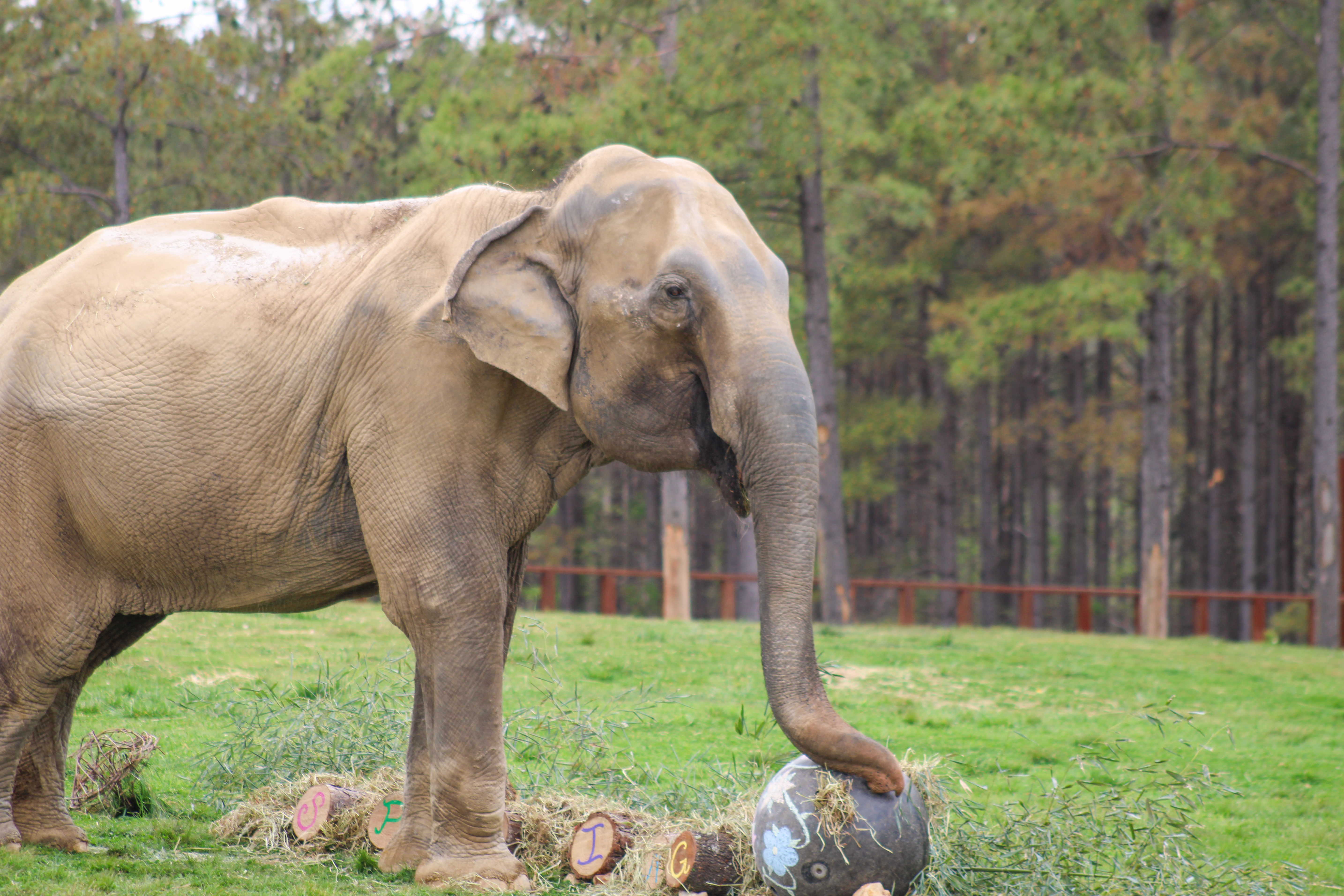
The elephants can choose at all times to be in the barn or out
roaming the hills, but much of their diet comes from browsing
the grounds. They have learned through the years which wild grasses
and other plants are tastiest in which season.
Three times a day the staff brings supplemental foods, vitamins
and medicines, wherever the animals may be. Keepers are convinced
the elephants seek out certain plants for medicinal purposes,
such as eating the bark of slippery elm or poison ivy leaves for
upset stomachs.
With the relatively mild Tennessee winters, Buckley said only
in January do the animals generally spend long periods in the
heated barns.
`It's not about you, here'
As big as the property is, it remains a captive enclosure, and
with captivity come some eccentric behaviors. The Tennessee hills,
for example, provide an endless stream of stray dogs, and a little
white one named Bella has become Tarra's pet.
"She lives and goes everywhere with Tarra," said Buckley. "Tarra
pets her with her trunk and her foot. Bella will roll over and
solicit belly strokes from Tarra."
One natural behavior Buckley will not allow is breeding.
"If they come here, we let them become extinct," she
said, underlining the philosophy that elephants should not be
in captivity. "There is a big difference between extinction
in captivity and in the wild."
Nor is the public permitted to see the elephants. The sanctuary's
electronically controlled gate swings open only for visitors on
prearranged business, though exceptions are sometimes made for
large donors.
"People go to zoos to be entertained," said Buckley. "We
say that elephants shouldn't be on display. Here, you don't get
to come on our grounds. It's not about you; here, it's about the
animals."
Instead, remote video cameras broadcast live footage through "Elecam," a
feature on the sanctuary's Web site, elephants.com. Buckley says
hundreds of people from all over the world regularly watch the
elephants, getting to know their lives in intimate detail. She
also uses Elecam as a teaching tool while lecturing in classrooms
via computer linkups.
Visitor center coming
Buckley expects tourism to increase after the sanctuary builds
a visitor center next year, though people standing on an observation
platform probably will never be closer to an animal than 300 yards.
The best view will be via 30 remote video cameras visitors will
use to locate and zoom in on elephants with handheld controls.
"There are alternative, more progressive ways to teach
and to not exploit the animals," said Blais. "Even if
you don't see the elephants with your own eyes from the visitor
center, we think you'll have a more powerful experience than if
the elephant was standing just 2 feet away from you.
"We hear from people in Hohenwald that the elephants won't
have an impact on them unless they can see the animals, but people
aren't going to get a true appreciation for them unless they see
them in a natural setting."
Stung by the campaigns against elephant captivity, the American
Zoo Association last week reported results from a Harris poll
showing that 95 percent of adult Americans believe zoos give children
greater appreciation of elephants and 94 percent believe children
are more concerned about animals they learn about in zoos.
In January, 78 zoos currently holding elephants in North America
announced long-range plans to expand their elephant collections
and to broaden research and support of surviving wild populations.
Taking notice of the sanctuary idea, AZA executive director
Sydney Butler said the zoo industry is considering trying something
similar--not hospices, but "conservation centers."
"AZA institutions have considered species conservation
centers, leading to larger spaces for animals," Butler said
during a recent Chicago visit.
The big difference would be that the zoo version would be a
breeding facility with bull elephants, resulting in "true
family herds, with infants." The centers probably would permit
public access and might shift family herds in and out of zoos.
"It has to be carefully considered for the future," said
Butler, stressing that plans for such centers are only preliminary.
Townspeople critical
In the town of Hohenwald, Buckley has garnered support from
civic leaders and has been enthusiastically received at schools,
where she volunteers to lecture.
Still, many residents are surprisingly sour about her and her
enterprise.
"You hear all about the elephants out there on television,
but as far as we're concerned, they're not here, because we never
see them," said Carolyn Bell, manager of Hohenwald's only
motel, which gets some business from occasional sanctuary visitors.
"I don't think bad about it; I just don't think it benefits
the town. I think they started it to give themselves a job. That's
my opinion, and a lot of other people around here think so, too.
"If it would let people in, maybe they'd think better of
it. Some kids around here will never see an elephant in their
whole life."
Buckley said she is aware of the negative undercurrents in the
area but believes those will disappear once the sanctuary visitor
center opens and begins to attract tourists.
She also insists the sanctuary is merely a bystander caught
in the struggle between the zoo industry and the animal rightists,
but she makes it clear that she thinks zoos need to pay attention
to her operation and change how they care for elephants.
"I don't see zoos ever becoming extinct," Buckley
said. "I see them getting managers who have a vision to change
their facilities to meet the needs of the animals. Instead of
a business mind, you need a visionary to run the zoos."
----------
wmullen@tribune.com