Washington
Post.com
By Mike Snow
May 4, 2008
Original
Article
GOLDEN
TRIANGLE, Thailand
At Anantara elephant camp, I met
Boon Rot, all 10 feet and three or so tons of
her, as she breakfasted on bamboo stalks. I'd
come to the resort to take part in mahout, or
elephant handler, training, and Boon Rot was
my assigned animal. Until recently, she'd had
the misfortune of roaming Bangkok's red-light
districts, exploited for novelty value by her
mahout, who sold tourists and other amused onlookers
bananas to feed her.
Her rescue by Anantara's "director of elephants," John
Roberts, meant that she'd be riding tourists
around instead. Not the perfect solution, former
elephant conservationist Roberts acknowledged,
but a big improvement for this 17-year-old tusker,
who would no longer have to face down cars, drunks
and other dangers of the concrete jungle.
Long revered for their intelligence and sensitivity,
elephants are Thailand's national animal. Elephant
Day is celebrated on March 13. A white elephant
appeared on the country's flag until 1917. The
animals once paraded members of the royal family,
served as super-weapons in Southeast Asian armies
and worked in the forests, hauling logs for the
Thai lumber trade.
But encroaching civilization and a 1989 ban
on logging sent the pachyderm population into
a tailspin. From about 100,000 at the turn of
the 20th century, its numbers have steadily dwindled
to a meager head count, as of last June, of 3,456
domesticated animals and another 1,000 or so
in the wild. These latter face an increasingly
bleak future, hunted both by vengeful farmers
whose crops they sometimes ruin and by ivory
hunters who covet their tusks.
Though about 300 elephants still live on the
streets of Thai cities, Boon Rot and the more
fortunate of her peers have found a way station
at trekking camps such as Anantara. These camps
are highly popular with tourists, but many are
notorious among animal rights groups, which say
that they are maltreating the creatures. This
was something I didn't learn until after my camp
experience, but it left me with a decidedly mixed
feeling about the whole thing.
Boon Rot seemed impossibly huge, and the thought
of mounting her gave me the heebie-jeebies. But
after hoisting myself up and coiling my legs
around her massive neck, I realized that she
was something of a pussycat. Riding her turned
out to be easier than it looked. As we plodded
along the trail, I gradually lost my fear of
falling off. Class ended on a high note when
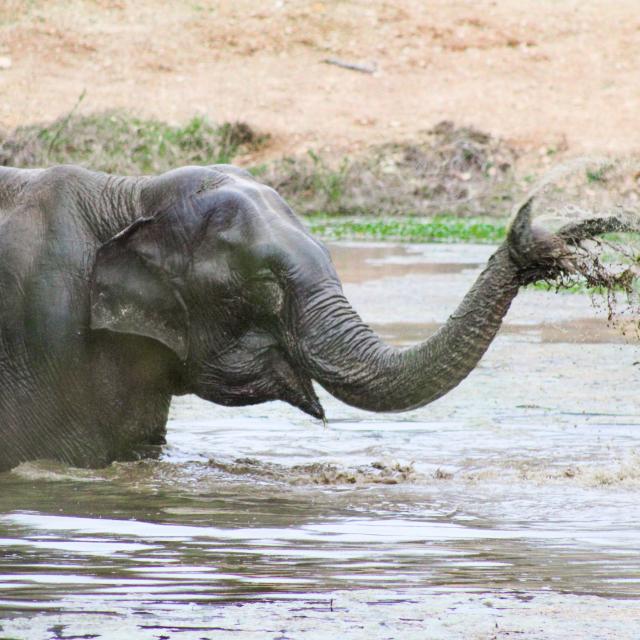
we students removed our tennis shoes and waded
into a river on our elephants for a refreshing
swim. After climbing back onto the riverbank,
the animals returned our shoes, one at a time,
with their trunks. We rewarded them with bananas
and then posed for a final round of picture-taking.
Marj, a British tourist who suffered from multiple
sclerosis, called the experience "one of
the best things I ever did."
The riding was certainly exhilarating. But is
it the best thing for the elephants? A look into
the crinkly, soulful eyes of Boon Rot and her
peers leaves little doubt that serving tourists
at Anantara, a kind of halfway house for elephants
attached to a five-star resort, beats sleeping
beneath garbage-strewn highway underpasses. But
the elephant camps aren't all equal.
Anantara, run by the Golden Triangle Asian Elephant
Foundation, appears to offer one of the better
elephant programs, promoting wildlife conservation
and the preservation of rural life, and offering
mahouts and their families a chance to earn a
living wage. It also caters to high-end tourists
and is therefore well funded. But elephants eat
10 percent of their body weight daily, so many
camps that operate on the margin feel pressured
to work their pachyderms hard to cover the cost
of their upkeep.
Most complaints of elephant abuse focus on the
way the animals are tamed. Anantara employs a
humane but time-consuming "tickling" method,
but many camps still use phaajaan (the Thai word
for "crush"), a method of domesticating
baby elephants that has been practiced in Thailand
for thousands of years. This ceremony involves
separating youngsters from their mothers, tying
them up in a confined space, jabbing them with
knives, heated irons, burning cigarettes and
bamboo sticks embedded with nails, pummeling
them with stones and other projectiles and depriving
them of food, water and sleep. It lasts for up
to six days, until a shaman senses that the elephant's
spirit is broken. Afterward, the animal is never
again permitted to see its mother.
Animal rights groups condemn not only the phaajaans
but also "imprisoning" the animals
and training them to perform tricks. "Elephants
don't have to dance, paint pictures or roll logs," says
Ashley Furno, senior campaign coordinator for
People for the Ethical Treatment of Animals (PETA). "We're
interested in protecting them so that they can
remain in the wild, free to spend their days
foraging for food, bathing and interacting with
their families and other elephants." In
2003, PETA mounted an ongoing Asia-wide ad campaign
protesting elephant abuse that has garnered attention
in Germany, Sweden, Singapore, the United Kingdom
and other countries that have traditionally contributed
to Thai tourism.
But because the elephant camps are privately
run, Thai officials find it difficult to address
abuses. Moreover, repeated turnover in governments
-- there have been three in 20 months -- means
that any high-level directives don't stick for
long, and interest in the issue waxes and wanes.
Officials have focused for the most part on providing
limited veterinary care. A project sponsored
by the queen to send elephants back into the
wild has had measured success, but Soraida Salwala,
founder of the private group Friends of the Asian
Elephant, charges that government support for
the sale of other elephants to Australian zoos
for a scientific breeding program helps promote
the wildlife trade.
The best hope for Thailand's elephants
would be government backing for sanctuaries such
as Elephant Nature Park and Elephant Haven, two
private, nonprofit sanctuaries near the Burmese
border that were established by animal rights
activist Sangduen "Lek" Chailert to
allow elephants to live in a protected natural
setting. Their exemplary work has riled those
unhappy at the prospect of replacing phaajaans
with more time-consuming breaking methods and
has earned Chailert death threats, but also recognition
by Time magazine as a "hero of Asia." Similar
sanctuaries have long operated in Africa.
A system of national parks could provide Thailand
and its tourist industry another valuable revenue
stream. But the biggest payoff would be helping
replenish the once robust population of Asian
elephants, now only about one-tenth the size
of Africa's (which numbers between 470,000 and
690,000, according to the International Union
for Conservation of Nature and Natural Resources).
Without sufficient funding and official support,
though, this seems unlikely to happen anytime
soon. So most of the burden of easing the pachyderm
population's decline falls on elephant camps,
which need better oversight and improvements
to make sure that they operate humanely.
On my final night at Anantara camp, as we sent
giant candle-powered paper lanterns known as
kum loys floating upward toward a star-filled
sky, I sent up with them my wishes that the once
stately elephant's run of bad luck might finally
come to an end.
mikesnow@starpower.net
Mike Snow is a Washington-based freelance writer
who reports frequently on Asia.
|